Every adversary has a tell. Iran's is geography.
For ten years the Islamic Republic and the proxies it arms have struck U.S. and allied targets with the same signature. Small target sets. Deliberate timing. Plausible deniability cutouts. Synchronized salvos engineered to overwhelm the most expensive air defense systems on the planet. Each attack is calibrated. Each is denied. Each leaves a trail of geolocated wreckage that disagrees with the denial.
The current war Tehran calls Operation True Promise 4 is not a new chapter. It is the latest entry in a decade long file. Read in sequence, the file reads less like a series of crises and more like a strategy executed across three U.S. administrations.
Part I. The Dossier
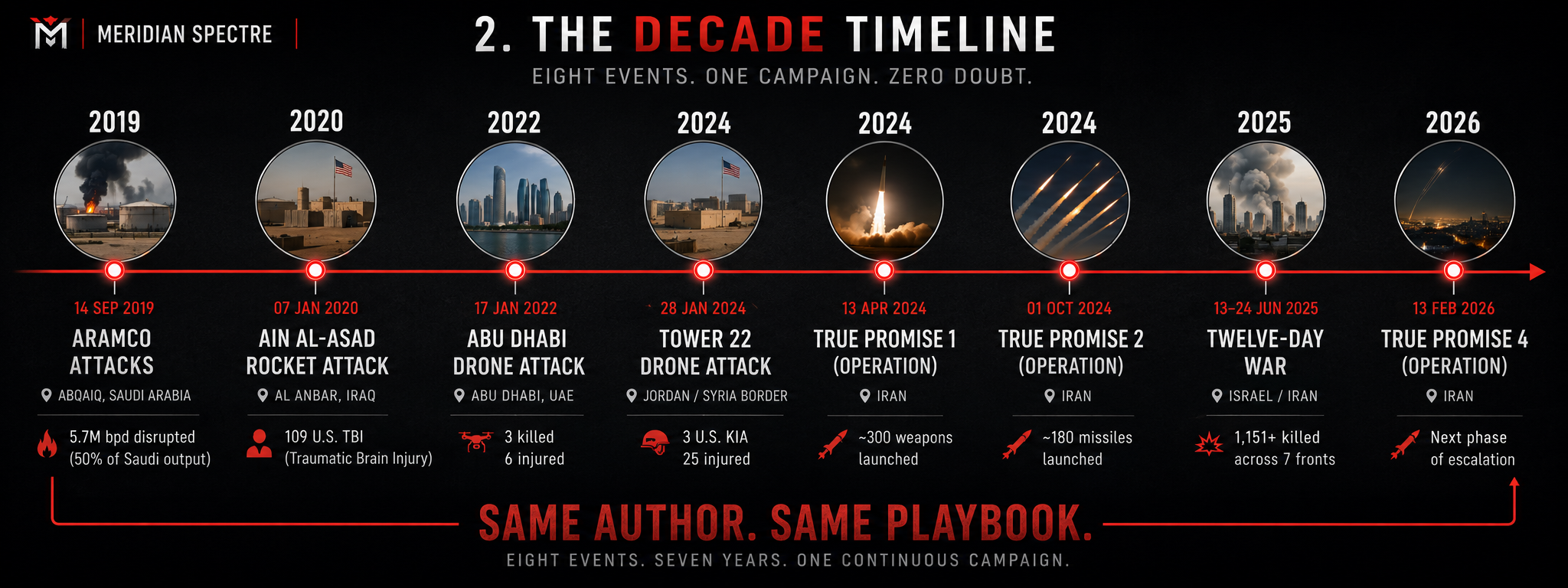
The decade in eight events
September 14, 2019. Abqaiq and Khurais, Saudi Arabia. Drones and cruise missiles, launched in synchronized waves, strike the world's largest oil processing complex. Half of Saudi Arabia's crude production goes offline. The Houthis claim it. The cruise missiles are Iranian. The U.S., Saudi, French, German, and British governments attribute the attack to Tehran. Iran denies everything. The template is set. Combined drone and missile salvos, an Iran armed proxy with the trigger, plausible deniability inside six hours, a target chosen for strategic effect over mass casualty. It will be repeated.
January 8, 2020. Ain al Asad, Iraq. Sixteen ballistic missiles, eleven on target. Five days after a U.S. drone kills IRGC Quds Force commander Qassem Soleimani in Baghdad, Iran fires the largest ballistic missile attack against a U.S. military target in history. President Trump's first statement reports no casualties. The Pentagon eventually confirms 109 traumatic brain injuries. CENTCOM commander Gen. Kenneth McKenzie estimates that without the 12 hour evacuation order he authorized, between 100 and 150 Americans would have been killed and 30 aircraft destroyed. The bunkers troops sheltered in were rated for 60 pound warheads. The Iranian missiles carried 1,000 pound warheads.
January 17, 2022. Abu Dhabi. Houthi fired Quds 1 cruise missiles and Sammad 3 drones, both Iranian supplied, both flown across 1,300 miles, strike oil tanker trucks and the Abu Dhabi airport extension. Two Indian and one Pakistani national are killed. A week later the Houthis fire ballistic missiles at Al Dhafra Air Base, which hosts U.S. forces. Both are intercepted. The UAE's first wartime breach in over fifty years has been delivered by an Iranian proxy from a country it shares no border with.
October 17, 2023 to January 27, 2024. Iraq, Syria, Jordan. Following the October 7 Hamas attacks and the start of Israel's Gaza campaign, an umbrella of Iran backed Iraqi militias calling itself the Islamic Resistance in Iraq launches more than 165 missile, rocket, and drone attacks on U.S. and coalition forces. The Pentagon counts roughly 70 service members with mostly minor injuries. The campaign is steady, almost industrial. Then on January 28, 2024, an Iran supplied one way drone fires from Iraq, threads U.S. defenses, and strikes Tower 22, a small logistics outpost in northeast Jordan supporting the Al Tanf garrison. Three U.S. soldiers are killed. Forty seven are wounded. The first U.S. combat deaths from enemy fire since the Kabul withdrawal. The drone slipped in alongside an American drone returning to base, and the confusion bought it the seconds it needed.
April 13, 2024. Operation True Promise. Iran's first direct attack on Israeli soil from Iranian soil. Three hundred standoff weapons in five hours. 170 Shahed 136 loitering munitions, 30 cruise missiles, 120 ballistic missiles. A coalition of Israeli, U.S., U.K., French, and Jordanian air defenses intercepts approximately 99 percent of the inbound mass. Nine ballistic missiles still strike Nevatim Airbase. The damage is small. The political precedent is enormous.
October 1, 2024. True Promise 2. Roughly 180 ballistic missiles, this time including Fattah 1 hypersonics and Kheibar Shekan models that reach Israel in twelve minutes. Pentagon assessment, roughly twice the scale of the April assault. Most are intercepted. Some hit Tel Nof and Nevatim airbases.
June 13 to 24, 2025. The Twelve Day War. Israel surprise strikes Natanz, IRGC commanders, and Iran's missile program scientists. Tehran responds with 550 plus ballistic missiles and 1,000 plus drones over twelve days. The U.S. joins on June 22, striking three Iranian nuclear sites in Operation Midnight Hammer. Iran retaliates by firing missiles at Al Udeid Air Base in Qatar, the central U.S. air operations hub in the region. Ceasefire holds June 24.
February 27, 2026. True Promise 4. And then the current war.
What the current war actually is
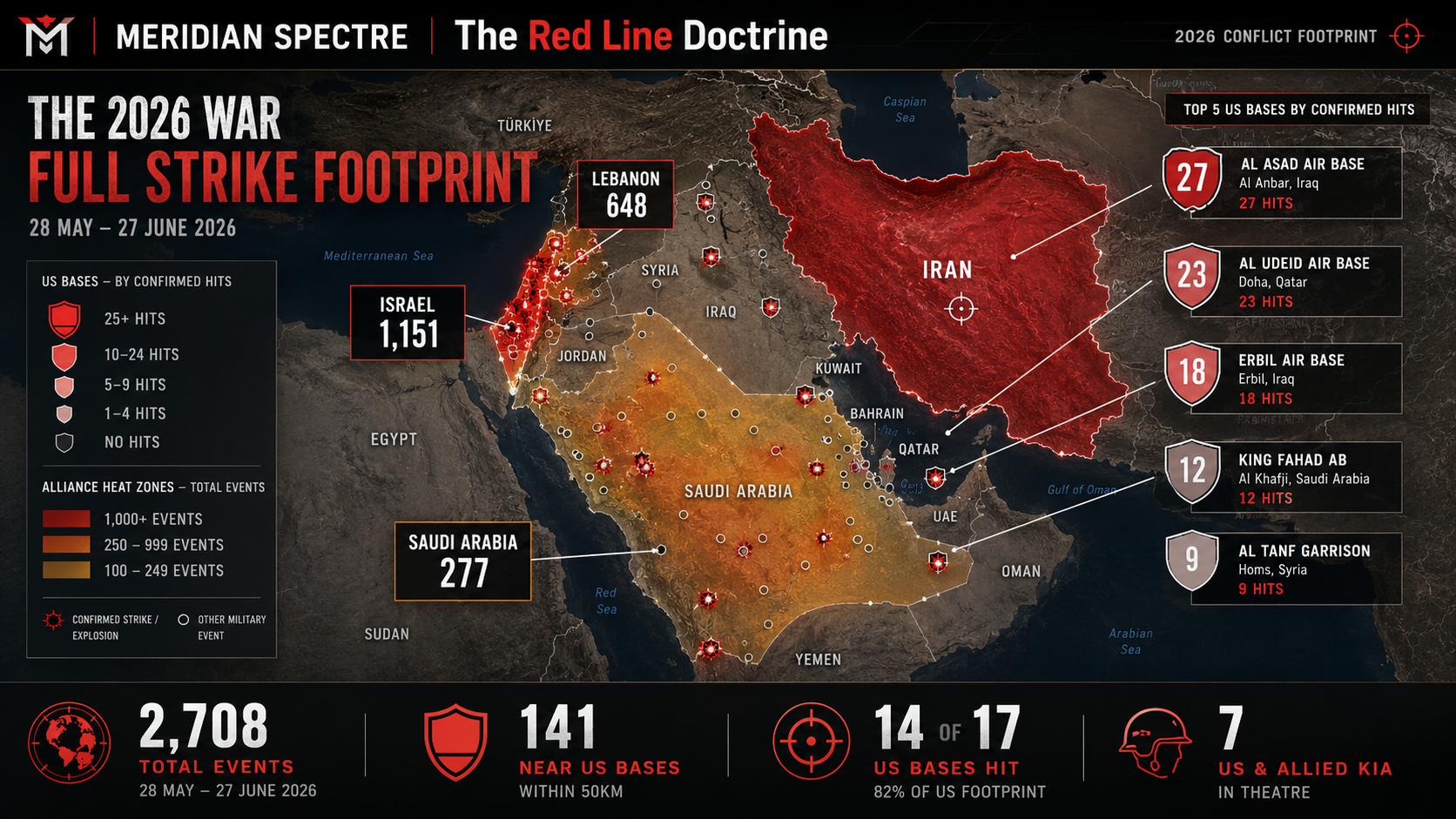
MERIDIAN's tracked strike dataset captured 2,708 Iran aligned strike events between February 27 and April 1, 2026, 34 days of open conflict.
| Target country | Strike events |
|---|---|
| Israel | 1,151 |
| Lebanon | 648 |
| Saudi Arabia | 277 |
| Iraq | 225 |
| UAE | 115 |
| Kuwait | 96 |
| Bahrain | 60 |
| Qatar | 47 |
| Jordan | 23 |
| Actor | Strike events |
|---|---|
| Hezbollah | 1,359 |
| Iran (direct) | 1,099 |
| Iraqi militias (various) | ~85 |
| Houthis | 7 |
Hezbollah and Iran's own ballistic missile force account for 91 percent of every shot fired. This is not a diffuse proxy war. It is two coordinated arms swinging from the same shoulder.
The American footprint
The Washington Post's satellite imagery investigation, published today, identified 228 damaged structures or pieces of equipment across 15 U.S. military installations since the war began. The Post geolocated 128 satellite images from Iranian state media and verified them against Sentinel 2 and Planet Labs imagery. 217 damaged structures, 11 destroyed pieces of equipment. Among the destroyed, an E 3 Sentry surveillance aircraft at Prince Sultan Air Base in Saudi Arabia, and a tactical operations center in Kuwait where six Americans were killed by a single drone in early March.
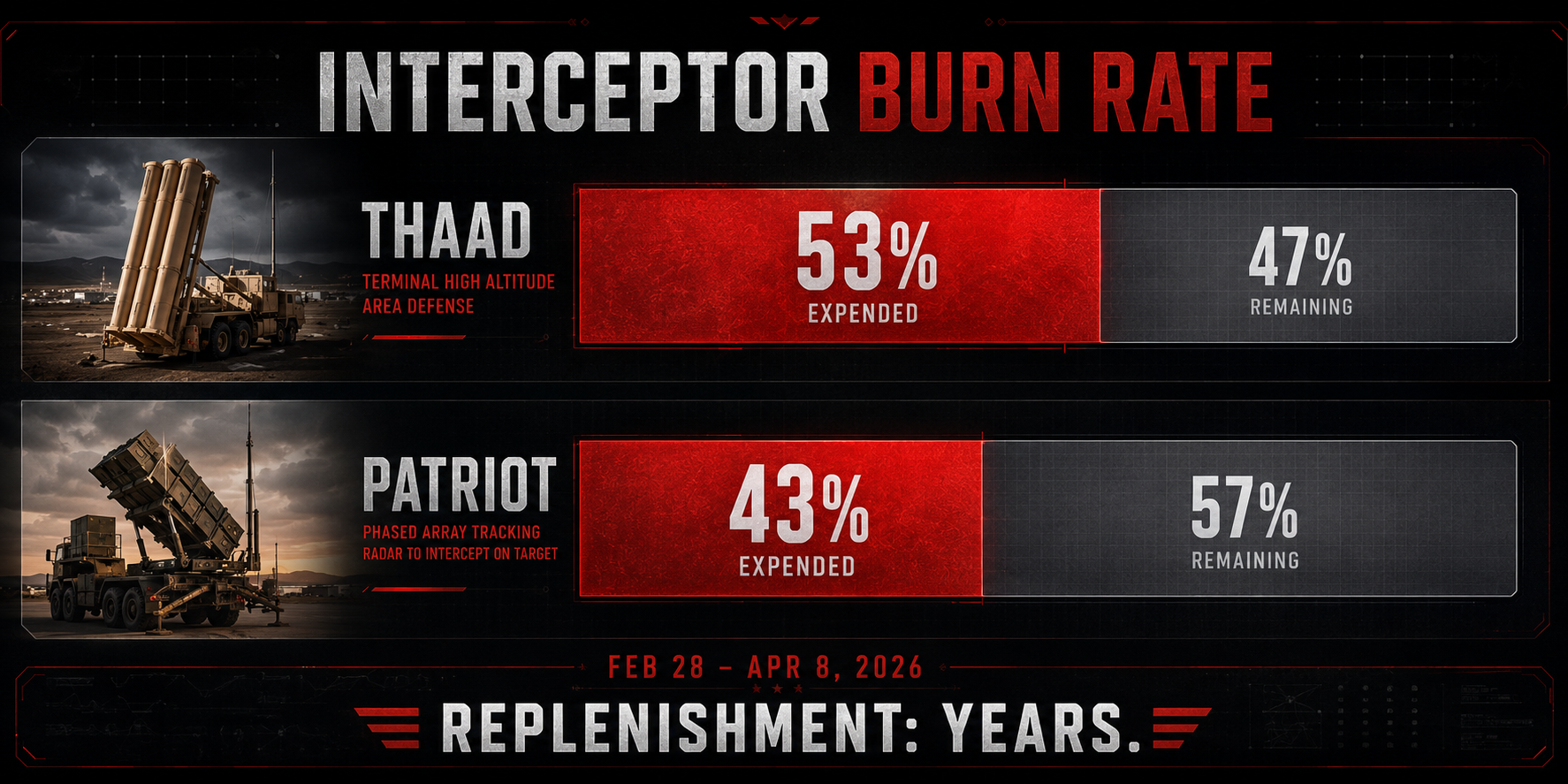
Seven U.S. service members have been killed. Six in Kuwait, one in Saudi Arabia. More than 400 troops have been wounded as of late April. Between February 28 and April 8, U.S. forces consumed an estimated 53 percent of THAAD interceptors and 43 percent of Patriot interceptors in the regional inventory.
MERIDIAN's tracked data shows the same war from the launch side. Of the 2,708 strike events, 141 landed within five kilometers of a U.S. base. Fourteen of seventeen named American installations took at least one hit. The geography is sharp.
| U.S. base | Strikes within 5 km |
|---|---|
| Union III / BIAP, Baghdad | 51 |
| Erbil Airbase, Iraqi Kurdistan | 25 |
| Naval Support Activity Bahrain | 16 |
| Muwaffaq Salti, Jordan | 11 |
| al Mubarak, Kuwait | 10 |
| Ali al Salem, Kuwait | 7 |
| Al Udeid, Qatar | 4 |
| Al Dhafra, UAE | 4 |
| Al Jaber, Kuwait | 3 |
Seventy six of those 141 strikes, or 54 percent, fell on two compounds in Iraq. Five bases account for 80 percent of all U.S. base adjacent strike activity in the war. This is not a region under fire. It is a handful of addresses, repeatedly, by an adversary with a list and the patience to work it.
That is the dossier.
Part II. The Red Line Doctrine
The section that follows is editorial analysis grounded in the tracked record above. It is the author's reading of administration posture from public action, not a reproduction of any official doctrine document.
What the previous decade taught Tehran
For ten years across three U.S. administrations, Tehran ran one experiment. The variable, how the West responds to a calibrated provocation. The control, the provocation itself. Same playbook, same cutouts, same denials, same diplomatic choreography afterward.
The results, written down honestly.
- 2019 Aramco. Multinational attribution to Iran. International response, sanctions and statements. Tehran's cost, minimal.
- 2020 Ain al Asad. 109 American TBI casualties. Public posture, relief that nobody died. Tehran's cost, minimal.
- 2022 Abu Dhabi. UAE territorial breach. Response, diplomatic condemnation. Tehran's cost, minimal.
- 2023 to 2024 proxy campaign. 165 attacks on U.S. forces. Response, scattered counterstrikes on militia infrastructure. No senior Iranian personnel touched. Tehran's cost, minimal.
- January 2024 Tower 22. Three Americans killed. Retaliation against Iraqi and Syrian militia compounds. Tehran's cost, minimal.
- April 2024 True Promise. Largest direct attack ever on Israel. Western posture, ask Israel to absorb it. Tehran's cost, minimal.
At every step, the country firing the missiles received the most diplomatic care. Tehran read this, correctly, as permission. Each attack made the next attack cheaper. Each restraint made the next restraint mandatory.
This is what restraint produced. Seven dead Americans this spring. An E 3 Sentry on the ground at Prince Sultan. Half the regional THAAD inventory burned to nothing.
What changed
The current administration is not surprised by the dossier because it read the dossier before it acted.
The U.S. participation in Operation Midnight Hammer during the Twelve Day War, B 2s on three Iranian nuclear sites, was the first move in a posture shift that did not exist under any prior administration. The response to Iran's missile fire on Al Udeid was not de escalatory. The response to True Promise 4 has not been de escalatory. Project Freedom, the carrier and destroyer escort operation transiting the Strait of Hormuz right now, is not de escalatory.
Read in isolation, each of those moves can be framed as escalation. Read against the file, they are calibration. The posture is a proportional response to a ten year provocation record that previous responses did not close.
The administration is not picking this fight. It is finishing one Tehran started in 2016 and has refused to end on terms anyone else has offered.
The four red lines, observable
The administration has not packaged this as a formal doctrine document. It does not need to. The posture itself draws four lines that are now legible from public action.
- No nuclear weapons capability. Enrichment on Iranian soil is no longer treated as a diplomatic file. It is treated as a kinetic file. Midnight Hammer demonstrated which way the line points.
- No untouchable proxies. Hezbollah, Kataib Hezbollah, and the IRGC chain that arms them are no longer separable from Tehran in U.S. responses. Strikes against U.S. forces are answered against the regime that ordered them, not just the militia that fired them.
- Open transit through Hormuz. Project Freedom is the operational expression. Twenty percent of global oil moves through that water. The line is that it keeps moving.
- U.S. forward bases are defended at the source. When the THAAD inventory is half spent in six weeks, the answer is not to stockpile more interceptors. It is to remove the launchers.
Each of these lines is a place where prior administrations would have absorbed a provocation and managed the diplomatic blowback. This one does not. That is the doctrine.
"At every previous step, the country firing the missiles received the most diplomatic care. The current posture is what changes when an administration finally treats the firing pattern as the diplomatic signal."
The "victim" performance is the trap
The most predictable thing in this war, more predictable than the strikes themselves, is what comes after them. Iran fires. Iran denies. Iranian state media releases "evidence" of American or Israeli aggression. Foreign ministers in European capitals call for de escalation. Within a week the conversation has shifted from what Tehran did to what we might do in response, and the de escalation pressure lands on Washington rather than Tehran.
This is not improvisation. It is information warfare run as professionally as the missile program. It works because it is designed to work, and it has worked because Western capitals kept rewarding it. The current administration's contribution is to stop running the script Tehran wrote. That, by itself, redraws the lines.
What the partners are paying
The bigger story underneath the U.S. casualty figures is the regional bill. Israel absorbed 1,151 strikes in 34 days. Lebanon, 648. Saudi Arabia, 277. The UAE, 115. Kuwait, 96. Bahrain, 60. Every one of those numbers is a partner of the United States taking damage on behalf of an alliance whose value depends on credible American deterrence.
This matters in places American voters cannot easily place on a map. It matters in Riyadh's oil revenue, in Abu Dhabi's tourism economy, in Manama's banking sector, in the daily lives of the people whose neighborhoods host the bases that keep American power forward deployed. The Gulf Cooperation Council states are doing the math on whether the deal, host the Americans, take the Iranian fire, is still worth signing. The current posture is what makes the math come out on the side of the alliance staying intact. Anything less credible would not.
- The dossier spans a decade. Aramco 2019, Ain al Asad 2020 (109 TBI), Abu Dhabi 2022, Tower 22 2024 (3 KIA), True Promise 1, 2, and 3 (2024 to 2025), True Promise 4 (Feb 2026). Same playbook. Same author. Three U.S. administrations.
- 2,708 Iran aligned strike events in 34 days of the current war. 141 within 5 km of a U.S. base. Fourteen of seventeen named American installations hit at least once.
- Hezbollah and Iran direct fire account for 91 percent of attribution (1,359 + 1,099 of 2,708). Houthis, 7. This is not a diffuse proxy war.
- Seven U.S. service members killed, 400 plus wounded. Six dead in Kuwait, one in Saudi Arabia. E 3 Sentry destroyed at Prince Sultan AB.
- 53 percent of regional THAAD interceptors and 43 percent of Patriot interceptors expended between Feb 28 and Apr 8. The next salvo arrives against a thinner shield. Replenishment takes years.
- Partners absorbed 2,529 strikes, nearly twenty times the volume hitting U.S. bases. Alliance cohesion in the region depends on credible deterrence at the source.
- Four observable red lines define the current posture. No nuclear capability, no untouchable proxies, open Hormuz transit, U.S. bases defended at the launcher. The doctrine is legible from action.
Read the file
MERIDIAN's tracked dataset on the current war is open. 2,708 strike events. 141 within 5 km of a U.S. base. Fourteen of seventeen American installations hit. 76 of those 141, or 54 percent, concentrated on two compounds in Iraq. The geography is sharp. The signature is consistent with everything Tehran has done since 2016. The Washington Post's 228 damaged structures are the symptoms. The dossier is the diagnosis. The doctrine is the treatment.
Critics calling the current posture excessive are reading today's strikes. They have not yet read the file, or understood that the old red lines are no longer where they used to be.
Strike event data is sourced from MERIDIAN's tracked open source dataset, comprising 2,709 geolocated Iran and Iran aligned attack records ingested from publicly available conflict monitoring catalogs and verified against state media imagery. Records include date, location, attribution, target site, source links, and confirmation status. U.S. base locations are MERIDIAN's curated facility set of 17 named installations across CENTCOM.
Proximity matching uses a haversine distance threshold of 5 km between strike geolocation and base coordinate, close enough that targeting can be reasonably inferred. Records lacking valid geometry were excluded. Valid coordinates exceed 99 percent of the dataset.
Decade context events (Aramco 2019, Ain al Asad 2020, Abu Dhabi 2022, Tower 22 2024, Operations True Promise 1, 2, and 3, the Twelve Day War of June 2025) are sourced from open reporting cited under Sources.
Part I of this brief is data analysis. Part II is editorial interpretation grounded in the same record. Confidence in aggregate strike counts and geographic concentration is HIGH. Confidence in damage attribution at any specific base is MEDIUM. For that, the Washington Post's May 6, 2026 satellite imagery investigation provides the most rigorous public count to date.
- Iran has hit far more U.S. military assets than reported, satellite images show. The Washington Post, May 6, 2026. washingtonpost.com
- Operation Martyr Soleimani / Ain al Asad strike. Wikipedia (consolidated CENTCOM, Pentagon, CBS 60 Minutes reporting). wikipedia.org
- 109 U.S. Troops Suffered Brain Injuries In Iran Strike. NPR, February 11, 2020. npr.org
- Tower 22 drone attack. Wikipedia / CBS / CNN, January 28 to 29, 2024. wikipedia.org
- 2022 Abu Dhabi attack. Wikipedia / Atlantic Council, January 17, 2022. wikipedia.org
- Abqaiq Khurais attack. Wikipedia, September 14, 2019. wikipedia.org
- April 2024 Iranian strikes on Israel (Operation True Promise). Wikipedia / Al Jazeera / BESA Center. wikipedia.org
- October 2024 Iranian strikes on Israel (True Promise 2). Iran Primer, USIP. iranprimer.usip.org
- Twelve Day War / Operation Midnight Hammer. Wikipedia, June 13 to 24, 2025. wikipedia.org
- MERIDIAN tracked dataset. Internal Iran/Axis strike records, Feb 27 to Apr 1, 2026.