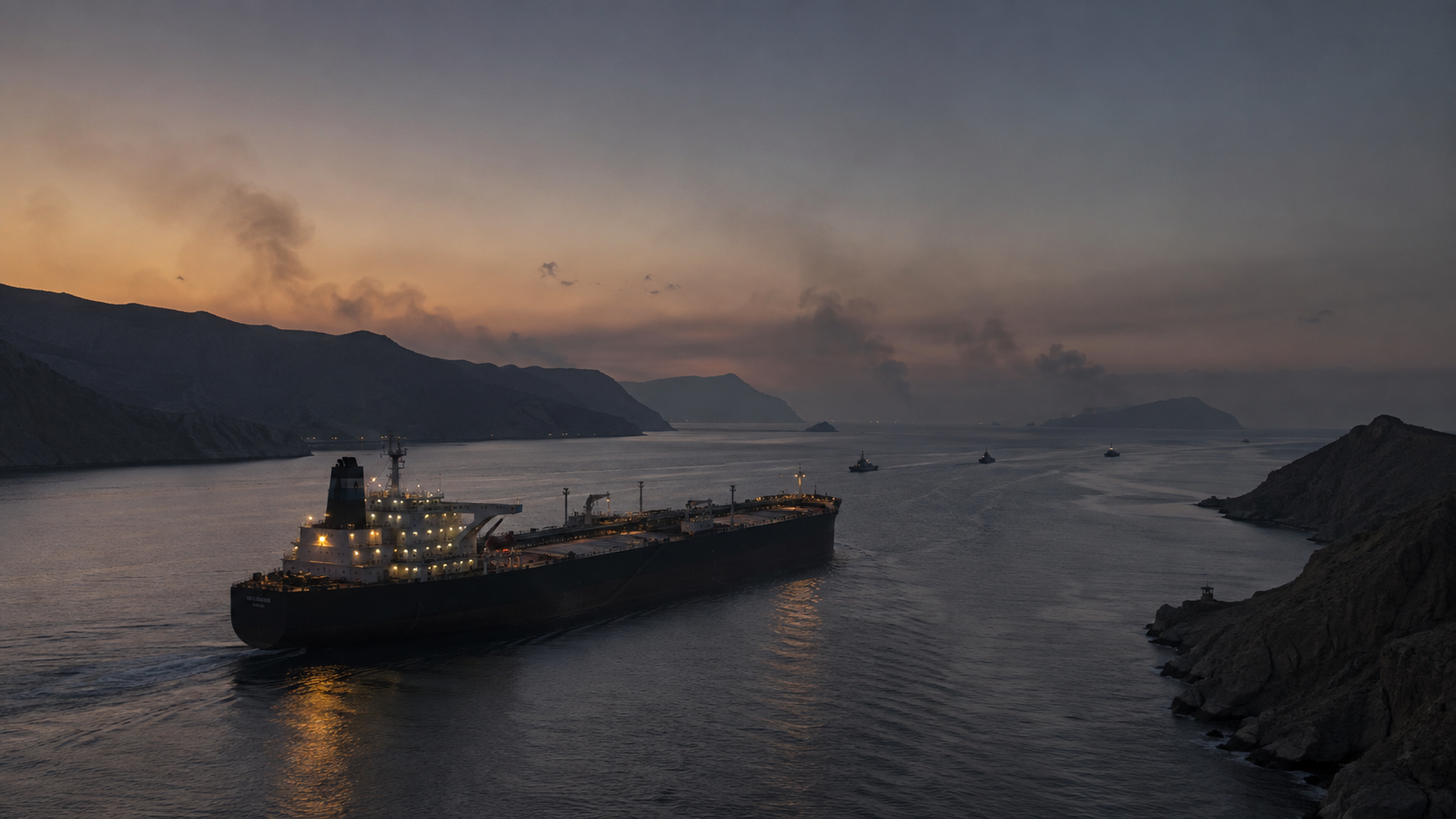
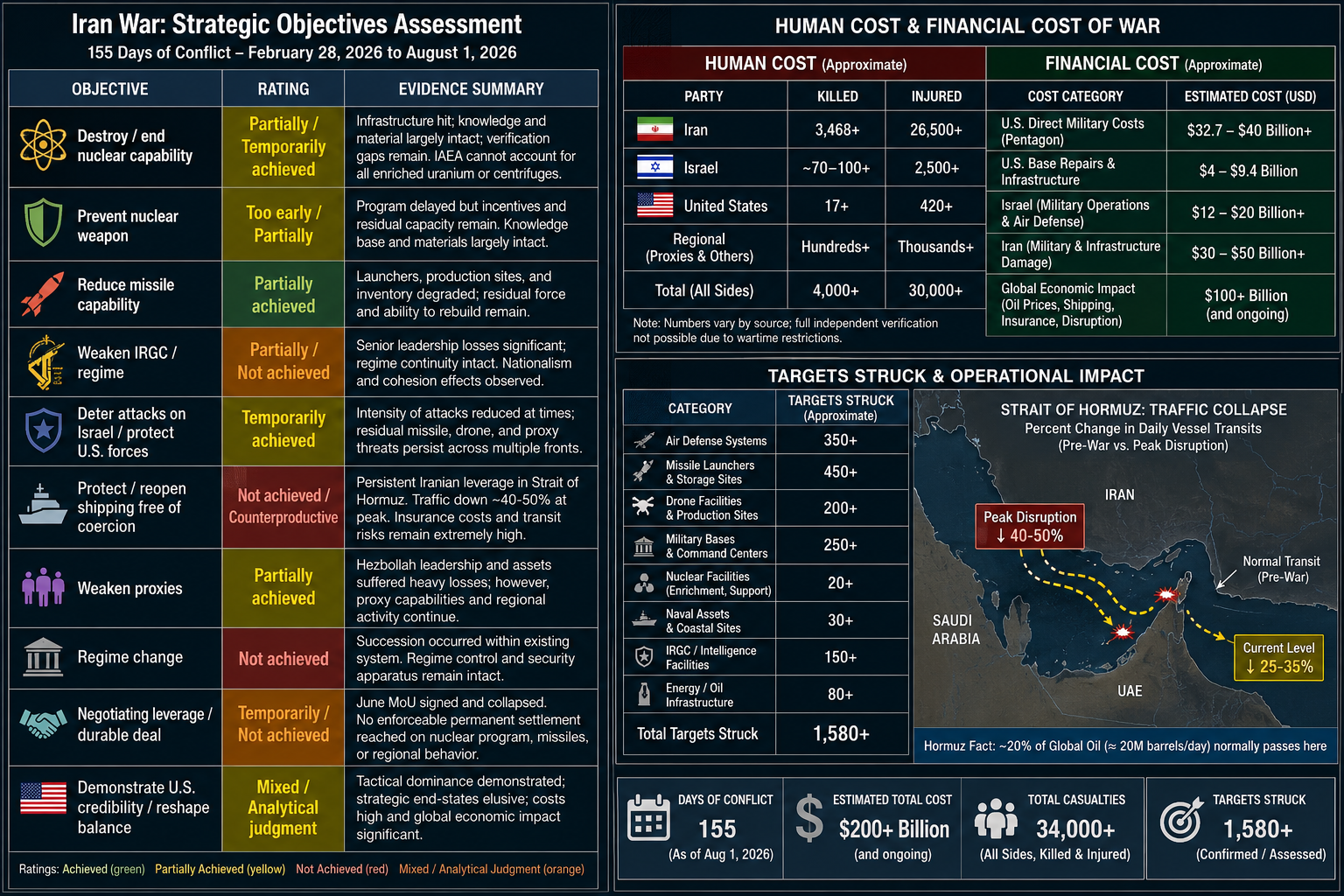
- 1,580 plus targets destroyed across air defenses, missile launchers, drone facilities, military bases, nuclear support sites, naval assets, IRGC facilities, and energy infrastructure.
- Approximately 13,000 plus killed and 70,000 plus injured across all parties. Iran carries the largest share. Full independent verification is not possible under wartime restrictions.
- $200 billion plus direct military cost at the mid range. When shipping disruption, oil shock, and reconstruction are added, total cost estimates run $1 to $2 trillion, with a $2 trillion plus scenario if Hormuz remains closed.
- Nuclear program damaged, not eliminated. The IAEA cannot fully account for enriched uranium, centrifuges, or surviving underground capabilities. Knowledge base and material remain largely intact.
- Strait of Hormuz transit down 25 to 50 percent depending on the reporting window. Iran does not need to close the Strait. It only needs to create enough uncertainty to slow vessel traffic and raise insurance premiums.
- No enforceable settlement. The June US Iran Memorandum of Understanding was signed and collapsed. Iran has not surrendered. Its government remains in power. Hormuz is not open.
The war against Iran was supposed to demonstrate overwhelming American power. It did. American and Israeli aircraft penetrated Iranian airspace, dismantled air defense networks, destroyed missile launchers, attacked military bases, damaged nuclear facilities, and killed members of Iran's military and political leadership. Iran has suffered thousands of deaths, tens of thousands of injuries, and extensive damage to its military and civilian infrastructure.
But five months after the United States and Israel launched their coordinated attack on February 28, 2026, the more important question is no longer whether Washington can destroy targets inside Iran. It clearly can. The question is whether any of that destruction has produced the strategic outcome President Donald Trump promised.
Iran has not surrendered. Its government remains in power. Its remaining missiles and drones continue to threaten Israel, American forces, and Gulf infrastructure. Its nuclear program has been damaged but not verifiably eliminated. International inspectors still cannot account fully for Iran's enriched uranium, centrifuges, or surviving underground capabilities.
Most consequentially, Iran has transformed the Strait of Hormuz from a geographic vulnerability into its greatest strategic weapon. Tehran does not possess the conventional military strength to defeat the United States. It does not need to. It only needs enough missiles, mines, drones, fast boats, and coastal weapons to convince tanker operators and insurers that passing through the Strait could result in a billion dollar ship being damaged or sunk.
That threat has already disrupted vessel traffic, driven up shipping and insurance costs, contributed to a dramatic increase in oil prices, and forced Gulf governments to seek help not only from Washington, but from China.
The result is a deeply uncomfortable conclusion for the United States. Iran is significantly weaker militarily, but it may now possess more influence over the global economy than it did before the war.
Iran War Update. 155 Days of Conflict.
The current war began on February 28, 2026, when the United States and Israel launched coordinated attacks against Iran. As of August 1, the conflict has lasted 155 days, counting February 28 as the first day.
The opening campaign was presented as a decisive effort to destroy Iran's missile forces, military infrastructure, naval capabilities, and ability to obtain a nuclear weapon. Instead, the war has expanded into overlapping military, maritime, economic, and proxy conflicts involving Iran, Israel, the United States, Gulf Arab states, Iranian aligned militias, Hezbollah, and the Houthis.
There have been pauses, ceasefires, negotiations, and even an interim US Iran agreement announced in June. That agreement was supposed to reopen the Strait of Hormuz and begin a 60 day negotiating period over Iran's nuclear program. But the core issues were deferred, the two governments described the agreement differently, and renewed attacks caused the arrangement to unravel.
By July, the United States had resumed large scale attacks. CENTCOM reported striking more than 80 targets during one renewed round, while additional attacks continued for multiple consecutive nights. Iran retaliated against American military facilities and commercial shipping.
On July 31, Trump again threatened additional strikes. Iran was accused of attacking or threatening tankers in the Strait and launching drones against facilities in Kuwait and elsewhere in the Gulf.
This is no longer a limited operation with a clear beginning and end. It is a prolonged regional war.
The Human Cost of the Iran War
Iran has suffered the largest number of casualties. Iran's Health Ministry has reported approximately 3,468 deaths and more than 26,500 injuries since the war began. The official figures reportedly include hundreds of children and women. Independent casualty monitors have produced somewhat different totals, while the United States and Israel have claimed much higher numbers of Iranian military casualties. Because Iran has restricted information, conducted internet shutdowns, and limited access to some attack sites, no final independently verified count exists.
Israel has reported several dozen deaths and thousands of injuries resulting from Iranian missile and drone attacks, including injuries suffered while civilians were moving toward shelters. Published counts differ depending on whether they include military personnel, civilians, indirect injuries, and casualties on other fronts.
The United States has lost at least 17 service members according to Reuters reporting in July, while more than 420 had been wounded by that point. Earlier deaths included six American troops killed when an Iranian drone struck a US facility in Kuwait.
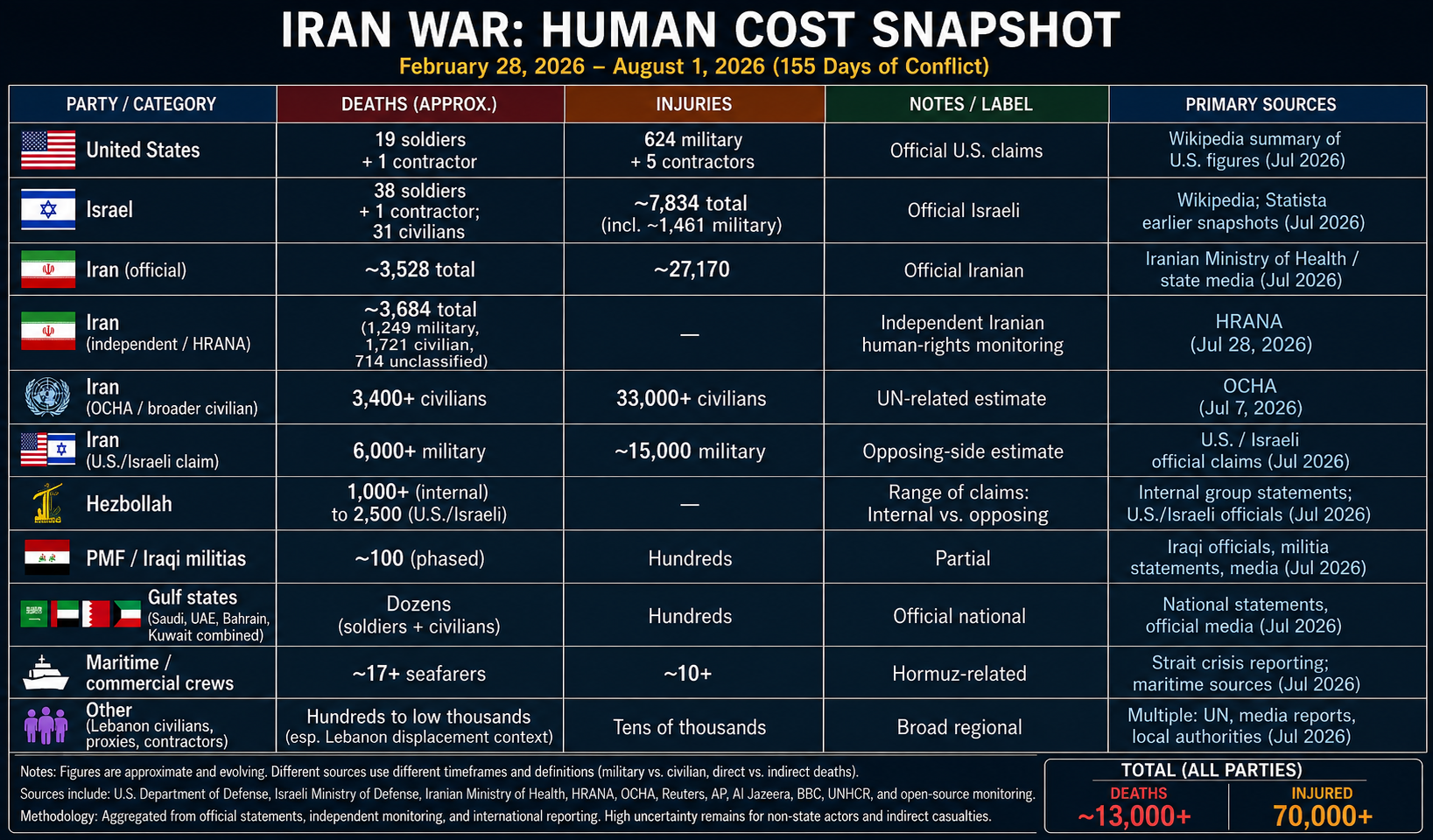
Those numbers do not capture the entire regional toll. People have also been killed or injured in Lebanon, Iraq, Yemen, the United Arab Emirates, Kuwait, Bahrain, and aboard commercial vessels. Iranian aligned forces have suffered substantial losses, while attacks on ports, energy facilities, military installations, and transportation systems have created secondary civilian consequences. The full cost will not be known until long after the fighting ends.
What Has the Iran War Cost? $200 Billion and Climbing.
The Pentagon's direct cost has been estimated at roughly $40 billion, although the final amount depends on whether analysts include base repairs, intelligence operations, equipment losses, and weapons that must eventually be replaced.
A June estimate from the Center for Strategic and International Studies placed the war's cost at approximately $40 billion, including between $4 billion and $9.4 billion for repairing and rebuilding damaged American bases. A later analysis found that the administration's supplemental request included approximately $32.7 billion attributed to war costs across the Defense Department and other federal agencies.
The opening days alone demonstrated how quickly modern warfare consumes money. An initial Pentagon estimate placed the cost of the first six days at approximately $11.3 billion.
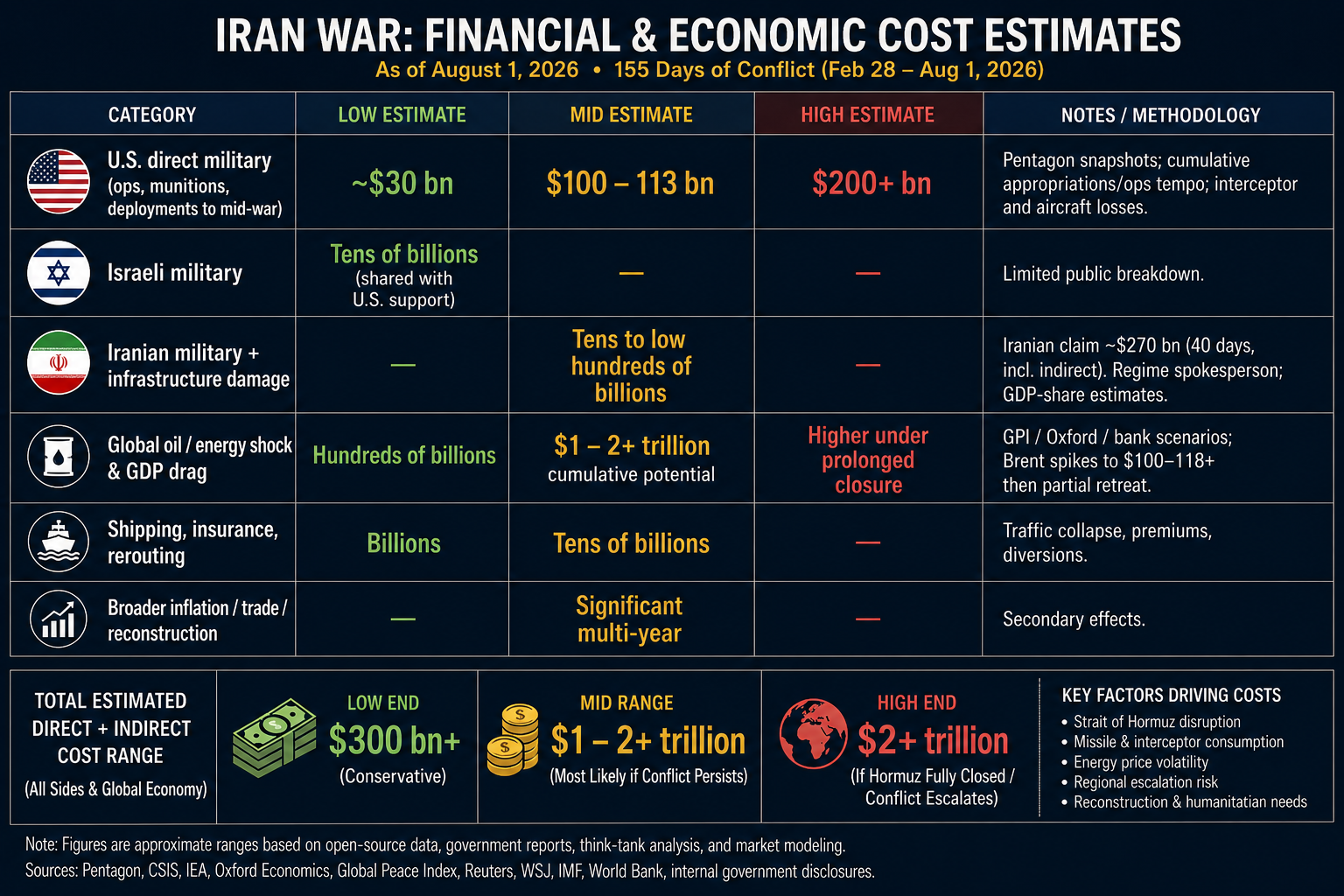
The price is not simply the cost of dropping bombs. The United States has expended expensive Patriot and THAAD interceptors defending bases and allies against relatively inexpensive Iranian missiles and drones. Cruise missiles, precision guided weapons, aircraft operations, naval deployments, intelligence missions, and damaged facilities must all be paid for.
Iran has also suffered tens of billions of dollars in military and infrastructure damage. Israel has incurred extensive costs for air defense, mobilization, military operations, business interruption, and civilian recovery. The broader economic losses may eventually dwarf the direct military spending.
Oil prices surged in July as attacks resumed and shipping through the Strait of Hormuz declined. West Texas Intermediate rose approximately 22 percent during the month, while Brent crude increased approximately 24 percent. ExxonMobil and Chevron warned that elevated fuel prices could continue through the second half of 2026 because of constrained crude shipments through Hormuz, tight fuel inventories, and disruptions affecting the broader refining system.
This is where Iran's strategy becomes clear. Tehran cannot match America aircraft for aircraft or missile for missile. But it can force the United States and its allies to spend millions of dollars intercepting cheaper weapons while simultaneously threatening the energy route on which the world economy depends.
1,580 Targets Destroyed. What Was Actually Accomplished?
The United States and Israel have struck Iranian nuclear facilities, missile production sites, air defense systems, launchers, naval assets, command facilities, communications networks, storage areas, ports, and government security organizations. The damage is unquestionably significant.
Iran's conventional forces are weaker. Its ability to launch coordinated large scale attacks has been reduced. Its air defenses proved unable to stop sustained American and Israeli penetration. Its missile and drone infrastructure has been attacked repeatedly. American military power performed as advertised.
But destroying a target and achieving a strategic objective are not the same thing. A launcher can be replaced. A drone factory can be moved. Missile production can be distributed among smaller facilities. Command functions can be transferred to new leaders. Centrifuges can be hidden underground.
The campaign has been highly effective at destroying visible infrastructure. It has been much less successful at forcing Iran to accept the political outcome Washington demands. Iran is still fighting.
Iran's Nuclear Program. Damaged, Not Ended.
Trump has repeatedly argued that Iran must never be allowed to obtain a nuclear weapon. But as of August 1, the United States has not demonstrated that Iran's nuclear program has been permanently eliminated.
The IAEA stopped conducting all in field verification activities in Iran in February because of the conflict. Although limited inspections later resumed at Bushehr, the agency has not regained the access required to account comprehensively for Iran's nuclear material and equipment.
An IAEA report issued before the war's later phases stated that Iran had not provided access to any of its four declared enrichment facilities during the reporting period. The agency therefore could not fully verify the location, quantity, chemical form, or enrichment level of Iran's uranium stockpile or the status of its centrifuges and related equipment.
Natanz was attacked again in March. Iranian nuclear authorities reported no immediate increase in off site radiation, but the attack confirmed that major nuclear locations remained active targets weeks after the opening strikes.
The known facilities have suffered serious damage. But a nuclear program is not merely a collection of buildings. It consists of scientific knowledge, enriched uranium, centrifuge components, manufacturing capacity, engineering records, underground facilities, and political intent.
Bombs can destroy centrifuges. They cannot destroy the knowledge required to build new ones. Nor can military strikes guarantee that all enriched material was destroyed rather than relocated before the attacks.
The most defensible conclusion is that the war has delayed, damaged, and decentralized Iran's nuclear program. It has not proven that the program is gone.
Worse, the war may have strengthened the argument inside Iran that only a completed nuclear weapon can prevent future American or Israeli attacks. Iranian leaders can now point to North Korea, which possesses nuclear weapons and has avoided direct American attack, and contrast it with Iran, which remained below the nuclear threshold and was bombed anyway.
That does not mean Iran has already decided to build a bomb. It does mean the strategic incentive has increased.
The Strait of Hormuz. Iran's New Center of Power.
The Strait of Hormuz is the narrow entrance connecting the Persian Gulf to the Arabian Sea. Roughly one fifth of global oil shipments normally pass through it.
Iran does not legally own the Strait. Oman controls the opposite side, and international law provides for transit passage. But maritime law cannot protect a tanker from a drone, mine, or antiship missile.
Iran has shown that it does not need to close the Strait completely. It only needs to create enough uncertainty to slow vessel traffic, increase insurance premiums, discourage shipping companies, and force governments to negotiate over safe passage.
On July 31, Iran claimed it had stopped two vessels from leaving the Strait and turned back four others. Reuters reported that some ships had been allowed to transit under negotiated arrangements, while US attacks and an American blockade of Iranian oil exports continued.
That is not uncontested military control. The United States remains capable of destroying Iranian ships, missile sites, radar systems, and coastal installations. It is something more subtle and, in economic terms, potentially more powerful.
Iran possesses a risk veto over normal commercial traffic. The US Navy may dominate the water and airspace militarily, but Iran can make commercial operators unwilling to enter. That is how a weaker state imposes costs on a stronger one.
Did Trump Turn Iran Into a Chokepoint Superpower?
Iran is not a conventional superpower. Its economy is far smaller than America's. Its conventional military cannot defeat the United States. Its cities, bases, and industrial sites remain exposed to attack.
But the war may have transformed Iran into a chokepoint superpower. A country capable of affecting the global economy far beyond what its military budget or economic size would ordinarily allow.
Before the war, Iran's ability to disrupt Hormuz was treated largely as a theoretical threat. The assumption was that Tehran would not seriously interfere with shipping because the United States would respond with overwhelming force. That deterrence calculation has now been tested.
The United States did respond with overwhelming force. Iran was devastated. And Iran continued interfering with shipping.
"A wounded chokepoint power with little left to lose."
That changes how governments, energy companies, and maritime insurers evaluate the threat. The war has demonstrated that American airpower can punish Iran, but punishment does not automatically compel Tehran to abandon the Strait or accept American nuclear terms.
Trump promised superior pressure would produce a superior deal. Instead, the June agreement postponed the hardest nuclear questions, and it subsequently unraveled.
As of August 1, Trump has not obtained:
- Iran's surrender.
- A permanent ceasefire.
- A verified end to uranium enrichment.
- Removal or destruction of all highly enriched uranium.
- A permanent international inspection regime.
- Guaranteed freedom of navigation through Hormuz.
- The elimination of Iran's missile and drone capabilities.
- A stable regional security arrangement.
The war therefore presents a brutal contradiction. Trump has demonstrated that the United States can destroy Iran's military infrastructure. He has not demonstrated that he can convert destruction into a lasting agreement.
The Strongest Case for Trump
There is a legitimate argument in defense of Trump's strategy. Iran's military has suffered severe losses. Known nuclear infrastructure has been damaged. Missile launchers, drone sites, naval assets, and air defenses have been destroyed. Senior figures have been removed. Iranian aligned forces across the region have been weakened.
Supporters can argue that Iran would have moved closer to a nuclear weapon if it had not been attacked and that negotiations without military pressure had repeatedly failed. They can also argue that the full effects of the campaign will not be visible immediately. Iran may eventually decide that rebuilding while facing continuing attacks is unsustainable.
That possibility cannot be dismissed. But it remains a future possibility, not a completed achievement.
The measure of a war is not simply how much of the enemy's infrastructure was destroyed. The measure is whether the political objective was achieved at an acceptable cost. By that standard, the result remains unresolved.
Putin's Iran Strategy. Opportunity Without Obligation.
Russian President Vladimir Putin does not need Iran to defeat the United States. He needs Iran to survive.
A surviving, isolated, and anti American Iran benefits Russia in several ways. The conflict diverts American air defenses, intelligence assets, ships, munitions, and political attention away from Europe and Ukraine. Higher oil prices increase the value of Russian exports. A weakened Iran becomes more dependent on Russian intelligence, technology, weapons, and diplomatic support.
Russia has publicly called for an end to hostilities while preserving its strategic relationship with Tehran. The Kremlin has avoided a direct military commitment that could trigger war with the United States.
US officials suspect Russia may have assisted Iran with targeting information, drone technology, or other forms of military intelligence. Trump said Putin had assured him Russia would not provide weapons, but Defense Secretary Pete Hegseth told lawmakers that Russia and China were involved with Iran in ways he would not specify.
The most credible interpretation is that Putin wants to provide enough support to keep Iran fighting but not enough to make Russia a direct combatant. His preferred Iran is damaged, dependent, and still capable of imposing costs on Washington. That is not friendship. It is strategic exploitation.
Xi's Iran Calculus. Alive but Hormuz Open.
China's calculations are different. Beijing wants Iran to survive American pressure, but it does not want the war to cripple Chinese energy imports.
China has been the dominant buyer of Iranian seaborne oil, reportedly purchasing more than 80 percent of those exports before the conflict. That trade gave Tehran economic support despite American sanctions and gave China access to discounted energy.
The war has placed China in an advantageous but dangerous position. Gulf Arab states have turned to Beijing in hopes that it can pressure Iran to reduce attacks and stabilize Hormuz. China has maintained dialogue with both Iran and the Gulf governments while avoiding direct confrontation with Tehran.
Beijing has also reportedly negotiated protections for Chinese shipping while showing little willingness to force Iran into broader concessions.
Xi Jinping's ideal outcome is not an Iranian victory. It is an Iran that:
- Survives.
- Remains hostile to US dominance.
- Continues exporting discounted oil to China.
- Consumes American military attention.
- Depends increasingly on Chinese trade and diplomacy.
- Avoids completely shutting down the energy route China needs.
China benefits when America is trapped in a costly conflict. It does not benefit when Hormuz remains unusable.
Has the Iran War Accomplished Anything?
Yes, but much less than its supporters promised. Iran's military is weaker. Its air defenses have been penetrated. Missile and drone infrastructure has been destroyed. Nuclear facilities have been damaged. Its economy has suffered. Its population has paid an enormous human price.
But Iran's government remains in power. Its remaining forces continue to strike back. The nuclear program has not been verifiably eliminated. Commercial navigation remains threatened. American troops remain exposed. Oil prices remain elevated. Russia and China have expanded their strategic opportunities.
Israel is safer from some destroyed Iranian weapons, commanders, and facilities. It is not necessarily safer from an Iran that now believes a nuclear weapon may be the only permanent deterrent against future attack.
The United States has shown extraordinary tactical power. It has not yet shown strategic control.
The Final Verdict
The war has been tactically successful, strategically inconclusive, and increasingly counterproductive. The United States and Israel have destroyed a large portion of Iran's visible military infrastructure. They have not forced Iran to surrender. They have not permanently ended its nuclear program. They have not secured the Strait of Hormuz. They have not produced an enforceable peace agreement.
Instead, the war has confirmed that Iran can use geography, low cost weapons, and a willingness to absorb punishment to impose enormous costs on the global economy.
Trump entered the conflict as the self described master deal maker. Five months later, there is no final deal.
Iran is battered, poorer, and militarily degraded. But it still controls the central variable shaping the war: whether the world can safely move energy through the Strait of Hormuz.
That does not make Iran a traditional superpower. It makes Iran something the world may find just as difficult to confront. A wounded chokepoint power with little left to lose.
This brief aggregates open source reporting from national defense ministries, independent human rights monitors, UN agencies, wire services, market analysts, and international financial institutions. Casualty figures diverge substantially between official Iranian counts, independent Iranian monitoring (HRANA), UN OCHA broader civilian estimates, and US and Israeli claims. All ranges are shown in the human cost chart above.
Financial estimates draw from Pentagon disclosures, CSIS analysis, Oxford Economics, IEA, Reuters and WSJ market reporting, and IMF/World Bank scenario models. The high end $2 trillion plus figure assumes prolonged Hormuz closure and sustained Brent above $100. Confidence is high on direct US military cost, medium on Iranian infrastructure damage, and low on total global economic drag due to compounding secondary effects.
Nuclear program status is assessed from IAEA reporting and public satellite analysis. Independent verification is limited because IAEA in field access remains constrained.
- Reuters wire reporting on US casualties, Iranian attacks, and Hormuz traffic, July 2026.
- Iranian Ministry of Health casualty figures, July 2026.
- HRANA independent Iranian human rights monitoring, July 28, 2026.
- UN OCHA civilian impact estimates, July 7, 2026.
- US Department of Defense and CENTCOM public statements, February to July 2026.
- Center for Strategic and International Studies cost analysis, June 2026.
- ExxonMobil and Chevron Q2 2026 earnings commentary on Hormuz oil supply.
- IAEA Iran verification reporting, February to July 2026.
- Wall Street Journal and Reuters coverage of Brent and WTI oil price movements, July 2026.
- MERIDIAN SPECTRE facility tracking dataset for Iran, IRGC, and non state actors.