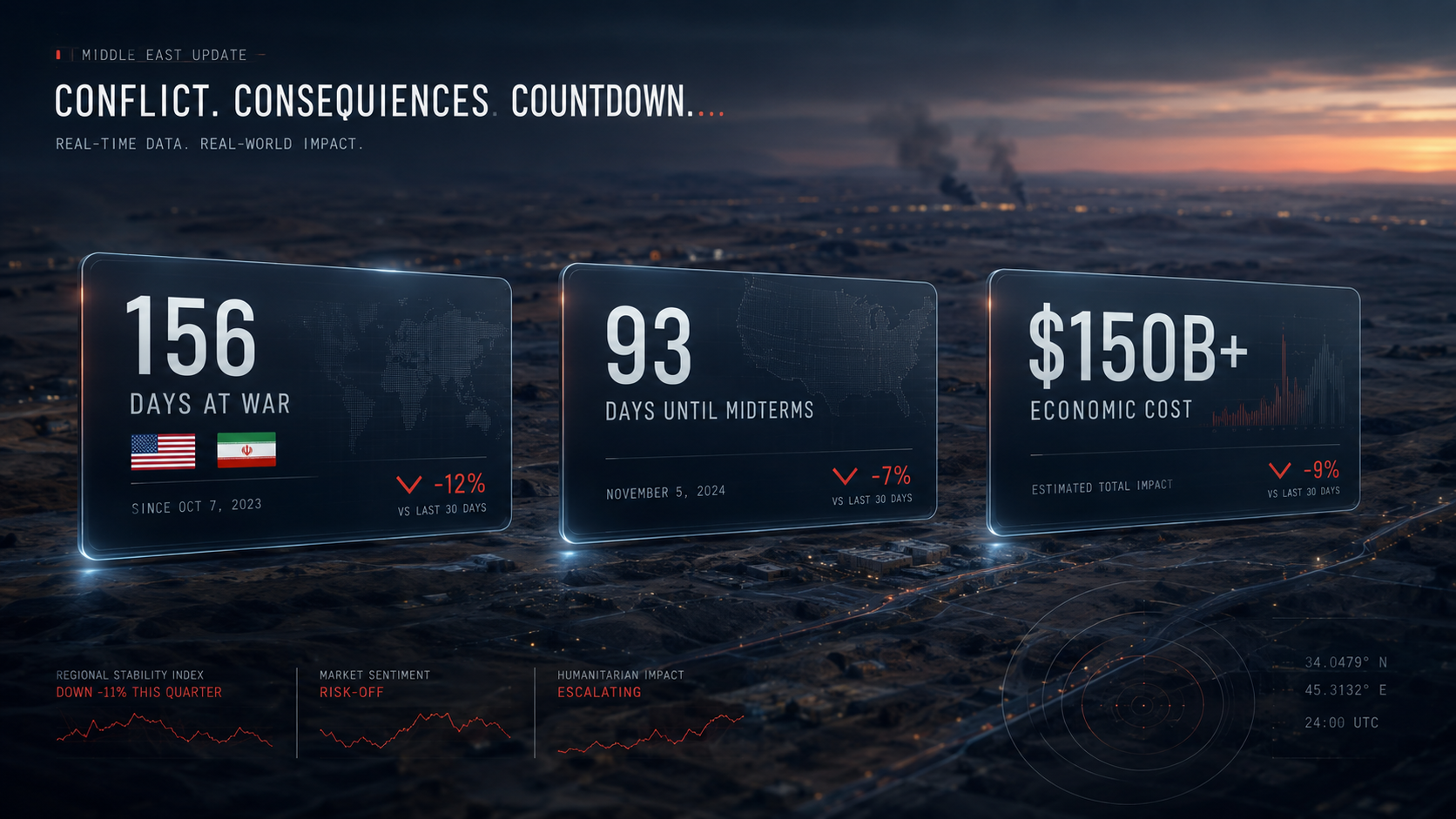
- Trump canceled a planned strike late Saturday after Iran and regional governments asked the United States to allow negotiations to continue. Saudi Crown Prince Mohammed bin Salman reportedly urged the pause, warning of catastrophic Gulf energy consequences.
- The State Department issued a broad regional security warning the same night telling Americans to be prepared to leave the Middle East in the event of unexpected escalation. Ten regional embassies circulated the alert.
- No completed agreement exists. Iran has not publicly endorsed every term Trump described. There is no released verification regime, no nuclear inspection framework, no defined consequence for violation, and no mechanism for holding Iran responsible for proxy attacks.
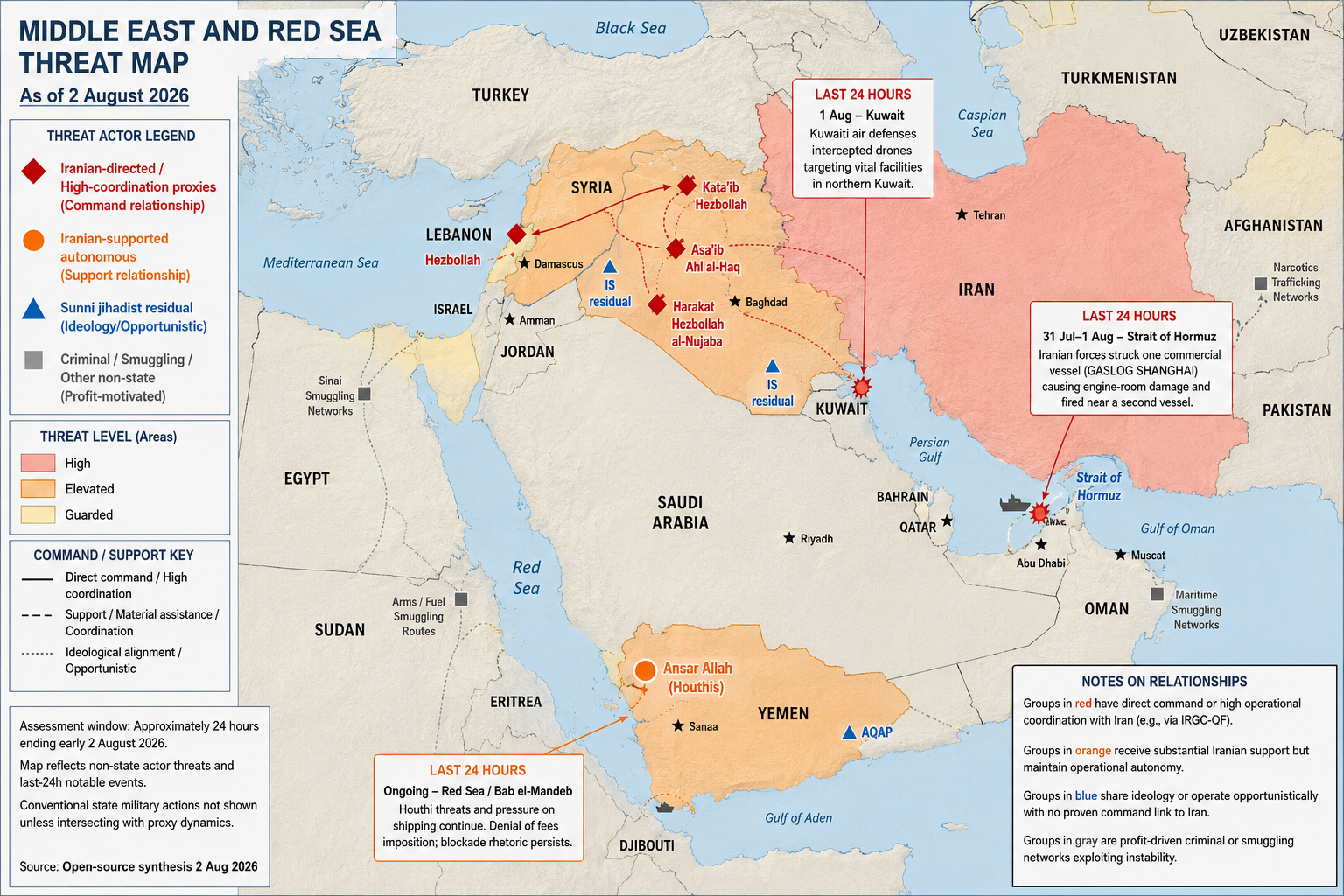
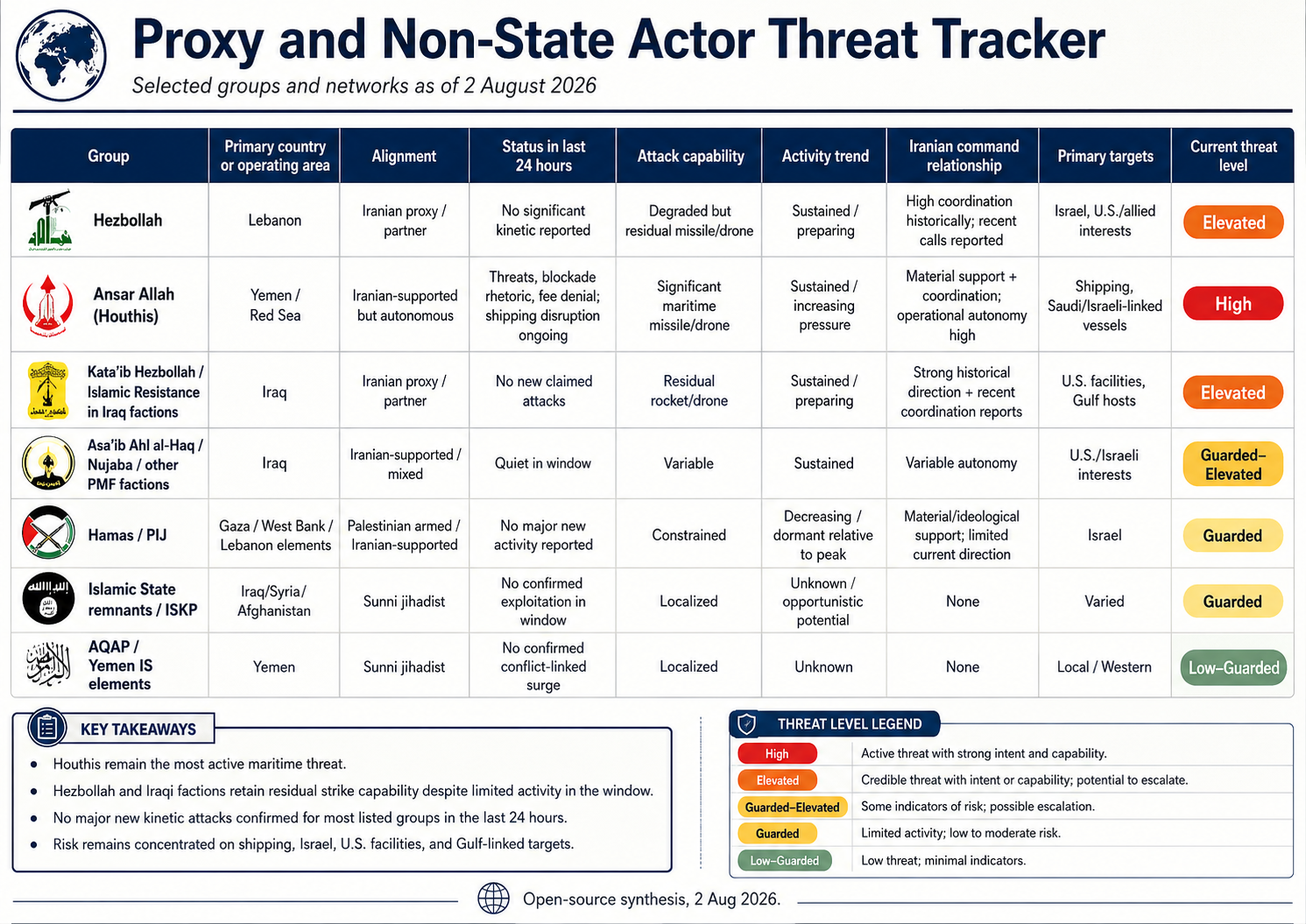
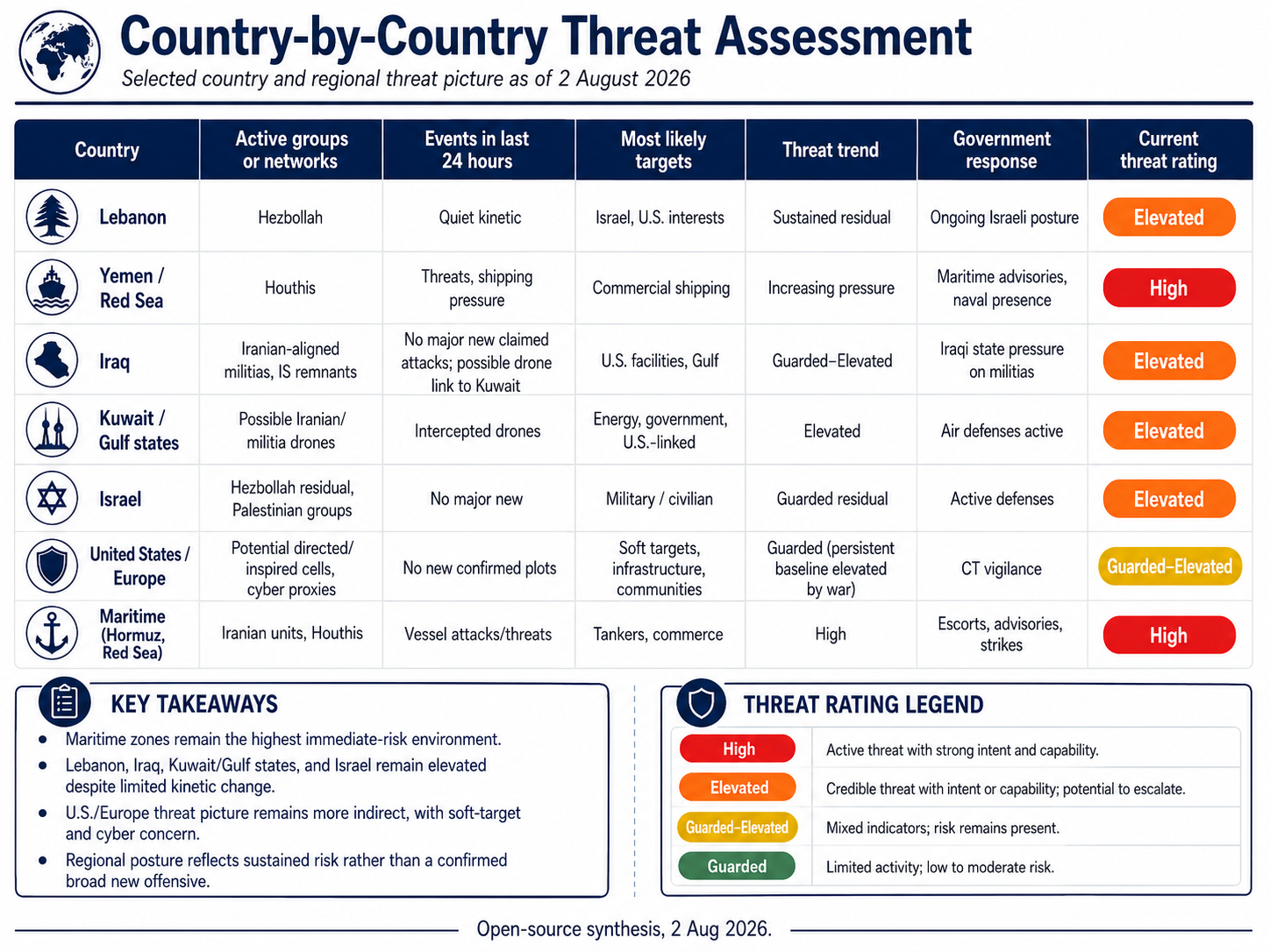
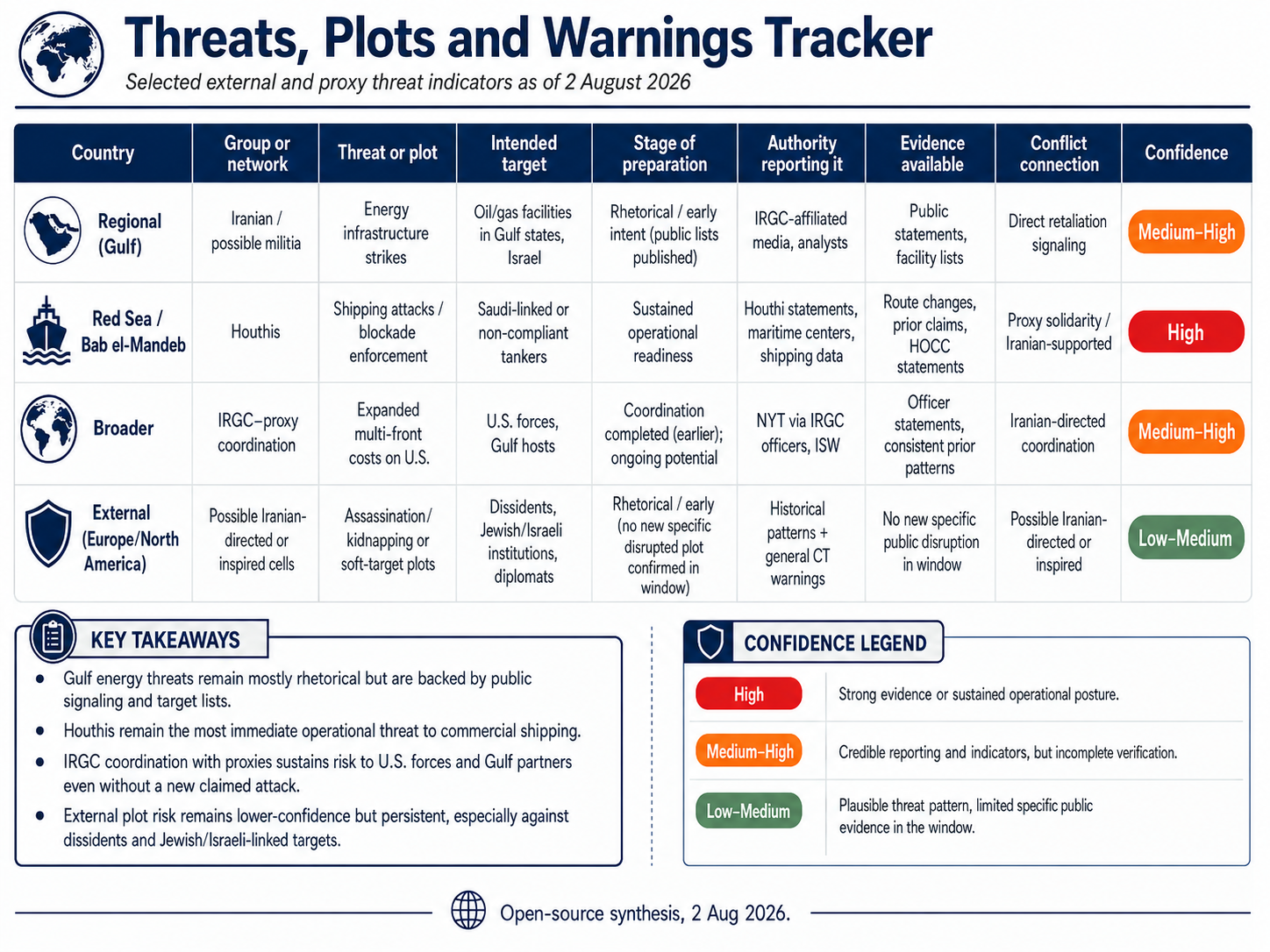
- The Houthis remain the most immediate operational threat. Iranian-supported but operationally autonomous. Continuing pressure on commercial shipping in the Red Sea and Bab el-Mandeb through the reporting window.
- Iraqi militias retain drones and rockets. A drone incident directed toward Kuwait during the last 24 hours has not been publicly attributed. Attribution remains qualified.
- Suspected cyber activity in the United States. Reports of Iran-linked activity affecting more than 30 community water systems in Minnesota are under investigation. Attribution has not been publicly confirmed.
- Overall proxy and non-state threat: Elevated. Concentrated on shipping, Gulf infrastructure, and US-linked facilities.
President Donald Trump called off a planned new round of strikes against Iran late Saturday, saying the United States would allow additional time to complete a potential agreement involving the reopening of the Strait of Hormuz and Iran's nuclear program.
But almost simultaneously, the US government warned American citizens across the Middle East to be ready to leave the region in the event of an unexpected escalation.
Taken together, the two announcements present a far more complicated picture than a simple diplomatic breakthrough.
Trump is telling Iran that the United States is prepared to suspend a major military attack if a deal can be completed rapidly. The State Department, meanwhile, is warning Americans that Iran and organizations supportive of Tehran may still attack US interests, diplomatic facilities, and locations associated with Americans around the world.
The administration may have paused its offensive operation. It has not concluded that the threat has ended.
That distinction is critical.
A Strike Plan Was Stopped, Not Eliminated
Trump said Saturday night that he had agreed to cancel an anticipated attack after Iran and other Middle Eastern governments asked the United States to allow negotiations to continue.
"We have just been asked by Iran, and other Middle Eastern Countries, to hold off any attack in that the perimeters of a deal has been agreed to," Trump wrote on Truth Social.
According to Trump, the prospective arrangement would include the "immediate, complete, and total" reopening of the Strait of Hormuz and an end to Iran's nuclear threat.
The president emphasized that the United States remained "locked and loaded" and conditioned the cancellation on the parties' ability to make a deal rapidly. Israel, Trump said, had joined the United States in supporting that commitment.
Multiple reports indicate that the United States had been considering a substantial bombing campaign against Iranian infrastructure. CBS News reported that US and Israeli planners had discussed what sources described as one of the harshest bombing campaigns of the conflict, potentially including Iranian energy infrastructure.
The operation was not merely theoretical political rhetoric. The administration had reportedly examined targets, timing, and military options before Trump reversed course.
Saudi Crown Prince Mohammed bin Salman reportedly urged Trump to avoid the attack, warning that Iranian retaliation could strike energy infrastructure throughout the Gulf and draw additional countries into the conflict. Other regional governments were also involved in the diplomatic effort.
That intervention may have prevented a severe escalation. It may also have demonstrated that Iran's threats against energy infrastructure and regional partners were influencing the decision-making process in Washington.
The State Department Is Preparing for the Deal to Fail
Before Trump announced the cancellation, the State Department issued a broad security warning to Americans in and traveling through the Middle East.
The warning advised Americans in the region to exercise heightened vigilance and be prepared for flight cancellations, periodic airspace closures, and travel disruptions. It told Americans to consider departing, or be ready to depart, if the conflict escalated.
The State Department also warned that US diplomatic facilities had been targeted and that Iran or groups supportive of Iran might attack additional American interests overseas.
US embassies across the region reportedly circulated the alert, including diplomatic missions in Bahrain, Iraq, Israel, Jordan, Kuwait, Lebanon, Oman, Qatar, Saudi Arabia, and the United Arab Emirates.
The State Department's worldwide caution specifically warns Americans in the Middle East to remain vigilant and prepare for transportation and airspace disruption. Its regional consular page directs citizens to monitor individual embassy alerts and enroll in the Smart Traveler Enrollment Program for emergency updates.
The warning is not evidence that an attack is certain. It is evidence that the US government believes the threat is credible enough to justify preparing American citizens for rapid deterioration. That includes the possibility that negotiations fail, that Iran retaliates despite the pause, or that an Iranian-aligned organization acts without waiting for a final order from Tehran.
The Contradiction at the Center of the Administration's Position
The administration is pursuing two policies at the same time.
Publicly, Trump is offering Iran a path to avoid another destructive round of bombing. Operationally, the State Department and US embassies are warning Americans that Iran and Iranian-supportive groups may attack US interests anywhere from the Gulf to locations outside the Middle East.
These positions are not inherently incompatible. Responsible governments continue preparing for war while pursuing diplomacy. But they reveal that the announced deal is not yet a reliable peace settlement.
Iran had not publicly confirmed every term described by Trump when he announced the cancellation. According to the Associated Press, Trump described the outlines of an agreement involving Hormuz and Iran's nuclear threat, but Tehran had not yet publicly endorsed the complete arrangement.
The Strait had not been demonstrated to be fully and permanently open under internationally acceptable conditions. No public verification regime had been released. No detailed nuclear inspection framework had been disclosed. No mechanism had been announced for determining whether Iran would be held responsible for attacks conducted by allied militias or semi-autonomous partners. No consequences had been defined publicly for another violation.
The United States therefore does not yet have a completed agreement. It has a proposed diplomatic off-ramp backed by a suspended military threat.
Does the Pause Make Trump Look Weak?
Negotiating instead of bombing is not weakness. A president who can obtain US objectives without additional casualties, destruction, or economic disruption should do so.
The danger comes from how the sequence is perceived by Iran and its regional network. From their perspective, the recent pattern could appear as follows: Iran attacks or interferes with commercial shipping. Iran threatens energy infrastructure in countries supporting the United States. Iranian missiles or drones target US forces and regional partners. Iranian-backed organizations raise the threat to Gulf facilities and international maritime traffic. Trump threatens overwhelming military retaliation. Regional governments warn Washington that striking Iran could produce catastrophic consequences. Trump pauses the planned operation and returns to negotiations.
That sequence could persuade Iranian leaders that escalation creates negotiating leverage. It could also encourage Iranian-supported organizations to believe that American threats are conditional while their own coercive activities produce political results.
There is no verified public statement proving that Hezbollah, the Houthis, or Iraqi militias have formally concluded that Trump is weak. But these groups have historically evaluated US credibility by comparing military warnings with the response that follows. They watch whether American casualties produce sustained retaliation, whether shipping attacks change US policy, and whether Washington de-escalates after regional partners warn of economic consequences.
The risk is therefore not that diplomacy automatically communicates weakness. The risk is that diplomacy following successful Iranian coercion may be interpreted as weakness unless the agreement forces Iran to make immediate, visible, and enforceable concessions.
Iran's Network Does Not Need to Attack as One Unified Force
The latest threat assessment shows that Iran's partner network is not a single military organization waiting for one centralized launch order. Different groups maintain different levels of Iranian direction, support, and autonomy.
Hezbollah remains closely coordinated with Iran but has been degraded by cumulative fighting. It retains residual missile and drone capability and continues to threaten Israel and allied interests.
The Houthis receive extensive Iranian material support and coordination but possess substantial operational independence. They remain the most immediate non-state maritime threat because of their missiles, drones, explosive boats, and capacity to threaten commercial traffic in the Red Sea and Bab el-Mandeb.
Kata'ib Hezbollah and other Islamic Resistance factions in Iraq retain rocket and drone capabilities that could be used against US installations, Gulf partners, or regional logistics networks.
Asa'ib Ahl al-Haq, Harakat Hezbollah al-Nujaba, and other Popular Mobilization Forces factions have varying relationships with Tehran. Their autonomy creates opportunities for plausible deniability.
Hamas and Palestinian Islamic Jihad remain Iranian-supported but currently possess more constrained capabilities.
Islamic State remnants and al-Qaeda in the Arabian Peninsula are not Iranian proxies. They could nevertheless exploit regional disorder, security gaps, or anti-American anger for their own purposes.
The overall proxy and non-state threat remains Elevated, with the greatest immediate concentration of risk around shipping, Gulf infrastructure, and US-linked facilities.
The Houthis Represent the Most Immediate Test
The Houthis could become the first organization to test whether the strike cancellation changed American deterrence. Their operational focus remains commercial shipping, especially vessels they characterize as connected to Saudi Arabia, Israel, or states supporting US operations.
Their pressure campaign does not require a direct Iranian order for every attack. That gives Tehran several advantages.
Iran can publicly support de-escalation while claiming that it does not control Houthi decisions. The Houthis can continue threatening vessels while presenting themselves as an independent Yemeni movement. Tehran can then benefit from continued economic pressure without accepting direct legal or political responsibility.
A Houthi attack during the negotiation period would therefore raise a decisive question: will the United States treat continued proxy pressure as a violation of the proposed agreement, or will it allow Tehran to separate its own promises from the conduct of the organizations it arms and supports?
If the answer is unclear, the Houthis may view the pause as an opportunity.
Iraqi Militias Could Apply Pressure With Plausible Deniability
Iranian-aligned Iraqi militias present a similar problem.
The latest reporting window contained no major new claimed attack by a named Iraqi faction. However, militia groups retain residual rocket and drone capability and have historically targeted American facilities in Iraq and Syria.
The possibility of militia involvement in drone activity directed toward Kuwait has not been confirmed publicly. That attribution must remain qualified.
But even an unsuccessful or deniable drone operation could achieve strategic effects. It can force air-defense activations, alarm Gulf governments, interrupt aviation, raise energy-market concerns, and remind regional states that cooperation with Washington carries risks.
The State Department's warning specifically recognizes the possibility that "groups supportive of Iran" may target US interests. That wording matters because it does not limit the threat to attacks ordered directly by the Iranian government.
Americans and US Facilities Are Part of the Battlefield
The new security alert expands the threat picture beyond military bases and oil tankers. The State Department warned that Iran and supportive groups could target US diplomatic facilities, American interests overseas, locations associated with the United States, places frequented by Americans, and targets outside the Middle East.
That creates a broader protective-security challenge. An Iranian response does not have to involve a ballistic missile strike on a military installation. It could take the form of a drone attack against a diplomatic compound, a rocket attack against a US base, sabotage of an energy or transportation site, an assassination or kidnapping plot, surveillance of Iranian dissidents, a threat against a Jewish or Israeli institution, cyber activity against civilian infrastructure, or an attack by an ideologically inspired individual.
There was no newly confirmed external terrorist plot in the latest 24-hour reporting window. That absence should not be converted into evidence that the threat does not exist. It means the public record currently contains a warning and an elevated threat environment, but not a verified new operational plot.
The threat outside the region remains best assessed as Guarded to Elevated rather than imminent or severe.
The Cyber Front May Be Expanding Inside the United States
Separate reports have raised concerns about suspected cyber activity affecting American water systems.
Cyber incidents involving more than 30 community water systems in Minnesota were reportedly under investigation, with possible Iranian or Iranian-affiliated involvement being examined. Attribution had not been publicly confirmed. That qualification must remain prominent.
A technical disruption, malicious intrusion, or unusual system event does not automatically establish that Iran was responsible. Final attribution requires forensic evidence, infrastructure analysis, intelligence reporting, and an assessment of the actor's methods and intent.
However, water and wastewater systems are logical targets for an Iranian or Iranian-aligned cyber campaign. Many local systems operate internet-connected industrial controllers. Smaller utilities may lack dedicated cybersecurity teams. Some operational-technology devices remain exposed online or continue using weak or default credentials.
Even where an attacker cannot contaminate water, it may be able to change controller settings, interrupt automated operations, trigger alarms, force manual operation, shut down equipment temporarily, create fear about drinking-water safety, or consume local and federal emergency resources. A limited cyberattack can therefore produce a psychological effect far greater than its technical effect.
If Iranian involvement is eventually confirmed, the incidents would indicate that Tehran or its supporters were attempting to extend the cost of the conflict directly into American communities. If Iranian involvement is disproved, the incidents would still demonstrate the vulnerability of local infrastructure during an international crisis.
Why the State Department Alert Changes the Meaning of the Strike Pause
Without the security alert, Trump's announcement might be presented primarily as a diplomatic decision: military action was prepared, regional governments intervened, and the president created space for negotiations.
The warning changes that interpretation. The US government was telling Americans to prepare for possible departure while the president was preparing to announce that an attack had been canceled. That indicates the administration understands at least four things.
First, Iran may not accept the complete agreement. Trump described the parameters of a deal. That does not mean Iran has accepted the same language, obligations, or enforcement mechanism.
Second, Iranian partners may continue acting. The Houthis, Hezbollah, and Iraqi factions do not all operate under identical command relationships. A ceasefire with Tehran may not automatically stop every organization.
Third, Iran may retaliate before an agreement is finalized. Iran could view continued military preparation, blockades, or Israeli actions as violations requiring a response.
Fourth, the conflict can expand beyond conventional battlefields. Diplomatic facilities, travelers, commercial aviation, civilian infrastructure, and soft targets may all be affected by escalation.
The alert therefore demonstrates that the military pause is not the same as restored stability.
What a Serious Hormuz Agreement Must Accomplish
A successful deal cannot simply reduce violence for several days. It must change the underlying conduct that created the crisis.
Immediate and unrestricted navigation. The Strait of Hormuz must be open to lawful commercial traffic without Iranian-imposed routing, unauthorized boarding, coercive inspections, or informal payment demands.
End attacks on civilian vessels. Iranian forces must stop missile, drone, projectile, mining, boarding, and sabotage operations against commercial shipping.
Remove maritime hazards. Any mines, explosive devices, unmanned systems, or other hazards deployed to threaten navigation must be identified and removed.
Establish nuclear verification. The phrase "end Iran's nuclear threat" is not operationally sufficient. The agreement must define enrichment restrictions, stockpile limits, facility access, inspection rights, monitoring procedures, and consequences for obstruction.
Address proxy operations. Iran cannot receive sanctions relief, commercial access, or military restraint from the United States while organizations it arms continue attacking US forces or international shipping. The agreement must specify how Iranian support, direction, or material assistance will be evaluated.
Protect civilian infrastructure from cyberattacks. Water systems, hospitals, energy facilities, transportation networks, and emergency services should be explicitly protected. A cyber operation conducted by an Iranian state unit or a group acting with Iranian direction should constitute a violation.
Define automatic consequences. The United States should not have to renegotiate its response after every missile launch, ship attack, or proxy strike. The agreement must establish clear consequences for specific violations.
What to Watch Over the Next 24 to 72 Hours
The success or failure of the pause will become visible quickly.
Iranian confirmation. Iran must publicly explain whether it accepts the conditions Trump announced. Material differences between the two versions would indicate that the supposed breakthrough is less developed than presented.
Vessel movements through Hormuz. Actual tanker traffic, shipping-company decisions, insurance pricing, and maritime advisories will reveal whether the strait is truly reopening.
Houthi operations. New vessel warnings, drone launches, missile preparation, or attacks in the Red Sea would show that the proxy front remains active.
Iraqi militia activity. Threat statements, rocket movement, or drone activity around US facilities could indicate that militias are testing the limits of the pause.
Embassy security measures. Further drawdowns, movement restrictions, or departure orders would indicate that the US government believes the threat has increased despite negotiations.
Commercial flight changes. Cancellations and airspace closures often provide an early operational indicator that governments and airlines expect deterioration.
Cyber incidents. Additional attacks against American water, energy, or transportation systems using similar methods could suggest a coordinated campaign, although attribution would still require evidence.
US military readiness. If US forces remain positioned and capable of striking quickly, the pause may retain coercive value. A visible reduction in readiness before Iran performs could weaken deterrence.
The Bottom Line
Trump's decision to stop the planned strikes may prevent thousands of casualties and avert a wider regional war. That outcome would be a major success if Iran genuinely reopens the Strait of Hormuz, accepts enforceable nuclear restrictions, ends attacks on commercial shipping, and restrains the organizations it supports.
But none of those outcomes has yet been conclusively demonstrated.
The administration's own security warning shows that Washington remains concerned about Iranian retaliation, proxy attacks, disrupted aviation, threats against diplomatic facilities, and attacks on Americans outside traditional military targets.
The alert also exposes the central weakness in any premature declaration of victory. The United States may have paused its strikes, but Iran's network remains armed. The Houthis remain capable of threatening shipping. Iraqi militias retain drones and rockets. Hezbollah retains residual capability. Possible cyber actors can reach civilian systems far from the Middle East.
Iran and its partners will now judge whether Trump's canceled attack was an act of controlled strength or evidence that pressure caused Washington to back down.
The answer will not be determined by another Truth Social post. It will be determined by whether ships move freely, whether Iran accepts verifiable restrictions, whether proxies remain quiet, whether Americans can remain safely in the region, and whether any violation produces an immediate and credible response.
The next 72 hours will show whether Trump created a real opening for peace, or gave Iran and its partners time to reorganize while the United States celebrated an agreement that had not yet been completed.
This brief synthesizes open source reporting from wire services, primary government statements, and independent monitoring across the reporting window ending August 2, 2026. Threat ratings for proxy groups and countries draw from published State Department alerts, maritime security bulletins, Houthi Operations Coordination Center statements, and MERIDIAN SPECTRE's tracked non-state actor dataset. Confidence is highest on publicly issued warnings and confirmed vessel activity. Confidence is lower on attribution of the Kuwait drone incident and the Minnesota water system events, both of which remain under investigation as of the research cutoff.
- Truth Social, President Donald Trump, statement on Iran strike cancellation, August 2, 2026.
- US Department of State Worldwide Caution and Middle East regional security warnings, July to August 2026.
- US embassy security alerts, Bahrain, Iraq, Israel, Jordan, Kuwait, Lebanon, Oman, Qatar, Saudi Arabia, and UAE, August 2026.
- Associated Press wire reporting on Trump strike cancellation and Hormuz negotiations.
- CBS News reporting on US and Israeli planning for potential bombing campaign against Iranian infrastructure.
- Saudi Press Agency and regional media reporting on Crown Prince Mohammed bin Salman intervention.
- Maritime security advisories from UKMTO and industry sources on Houthi and Iranian activity in the Red Sea and Strait of Hormuz.
- Reporting on suspected cyber activity affecting Minnesota community water systems, August 2026.
- MERIDIAN SPECTRE proxy and non-state actor tracking dataset.