- 1,293 confirmed strikes inside Iran through August 2, 2026, drawn from a MERIDIAN OSINT dataset of 4,938 sourced records and 4,303 dated event pins.
- Nearly 38 percent of confirmed strikes hit missile, air-defense, air-base, or aviation targets. The largest single category was missile facilities and air-defense systems at 280 strikes.
- 119 confirmed strikes hit naval, port, or maritime targets. Approximately 9.2 percent of the total. Iran still retains asymmetric maritime leverage.
- 229 confirmed strikes hit IRGC, Quds Force, security services, and command structures. The IRGC was damaged but retains dominance inside Iran.
- Only 15 confirmed strikes hit nuclear facilities. Iran's enriched uranium stockpile, centrifuge expertise, and underground infrastructure remain publicly unaccounted for.
- Iran continued launching ballistic missiles after months of attacks, proving surviving launchers, crews, targeting, and political willingness to use the force.
- The developing deal is a maritime and ceasefire arrangement, not a comprehensive settlement of nuclear, missile, IRGC, or proxy issues.
After more than five months of war, repeated US and Israeli strikes, major Iranian military losses, disrupted oil markets, and prolonged pressure around the Strait of Hormuz, President Donald Trump says an agreement with Iran may be close.
That may be accurate. Only within a limited context.
The United States and Iran appear to be moving toward an interim arrangement intended to reopen the Strait of Hormuz, reduce attacks on commercial shipping, and create space for additional negotiations. That would be meaningful progress. It would not constitute a comprehensive settlement of Iran's nuclear program, ballistic-missile forces, IRGC operations, proxy network, or long-term regional conduct.
The United States may therefore be close to a temporary maritime and ceasefire arrangement. It is not yet close to a verified and permanent resolution of the broader Iranian threat.
That distinction matters because there is no serious question that Iran suffered extensive military damage during Operation Epic Fury.
The real question is whether the campaign permanently accomplished the administration's stated objectives, or whether it imposed extraordinary damage while leaving Iran with enough surviving capability to rebuild, retaliate, and continue threatening the region.
The available evidence supports a mixed but increasingly clear conclusion.
Operation Epic Fury severely damaged Iran's military infrastructure, interrupted missile and weapons production, suppressed much of its conventional air-defense network, imposed major naval losses, and disrupted the command structure of the Islamic Revolutionary Guard Corps. Iran nevertheless remains a functioning regional power with surviving ballistic missiles, a resilient IRGC, active proxy relationships, the ability to threaten Gulf energy infrastructure and shipping, and an unresolved nuclear program.
The Trump administration is broadly correct about the scale and military focus of the damage. It is exaggerating how completely and permanently Iran's capabilities were eliminated.
What the Strike Dataset Shows
The MERIDIAN Operation Epic Fury OSINT dataset contains 4,938 sourced records, including 4,303 dated event pins. After consolidating multiple pins associated with the same incident, the records translate into approximately 1,968 unique dated events documenting US, Israeli, or combined US-Israeli military activity during Operation Epic Fury.
The merged analysis identifies 1,293 confirmed strikes inside Iran through August 2, 2026.
The campaign's operational priorities are unmistakable. The largest single target category was missile facilities and air-defense systems at 280 confirmed strikes (21.7 percent). Air bases and aviation targets accounted for 209 strikes (16.2 percent). Naval bases, ports, and maritime targets accounted for 119 strikes (9.2 percent). Power and energy infrastructure accounted for 97 strikes (7.5 percent). Police, intelligence, and security targets accounted for 92 strikes (7.1 percent). IRGC facilities accounted for 89 strikes (6.9 percent). Regular Iranian Army and IRIA sites accounted for 63 strikes (4.9 percent). Industrial and manufacturing accounted for 56 strikes (4.3 percent). Weapons and ammunition storage accounted for 33 strikes (2.6 percent). Basij sites accounted for 21 strikes (1.6 percent). Transportation infrastructure accounted for 16 strikes (1.2 percent). Nuclear facilities accounted for 15 strikes (1.2 percent). Command, control, and communications accounted for 14 strikes (1.1 percent). Government and administrative accounted for 8 strikes (0.6 percent). Quds Force accounted for 5 strikes (0.4 percent). The remaining 176 strikes (13.6 percent) are classified as unclassified in the merged dataset.
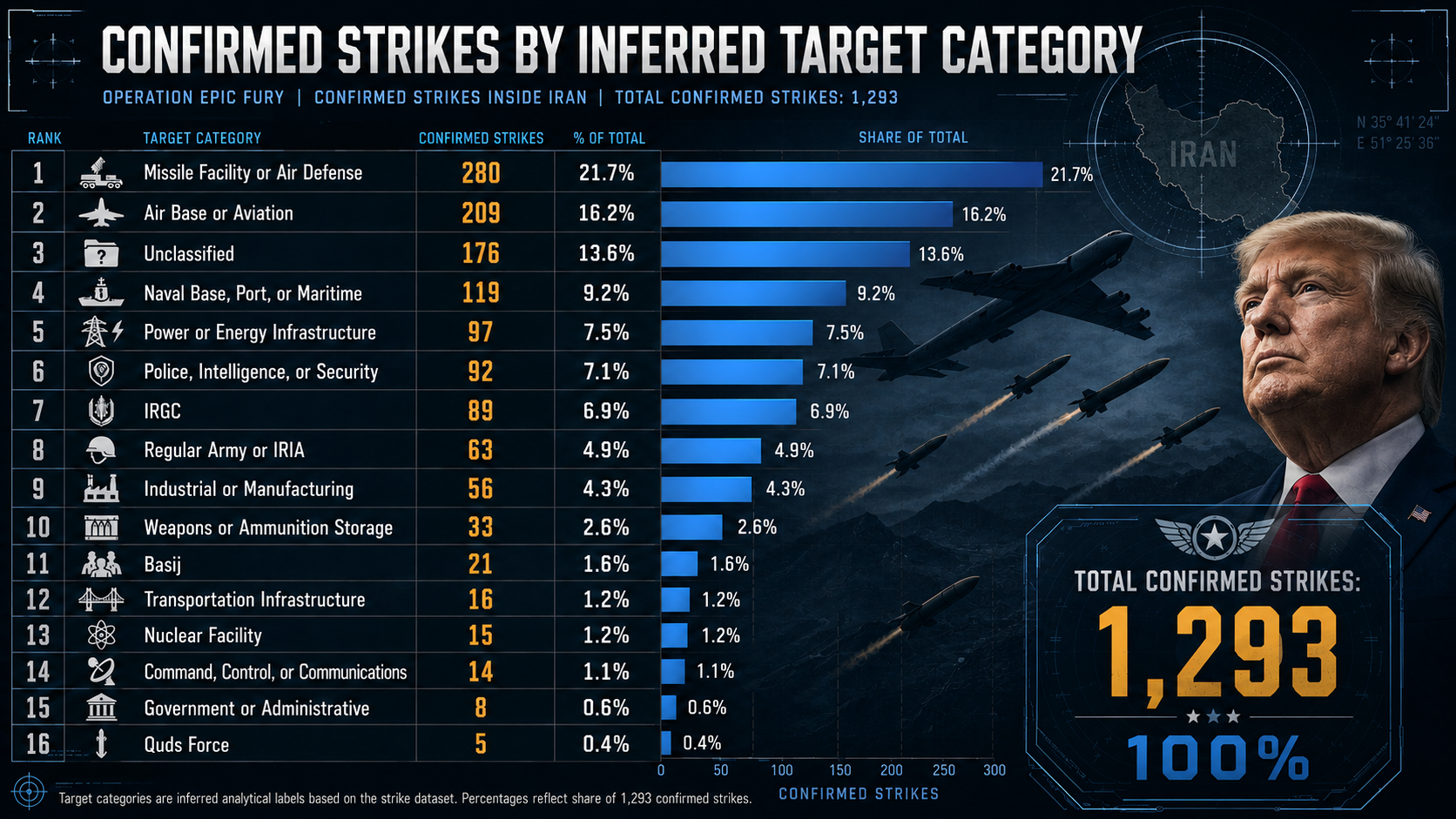
Nearly 38 percent of all confirmed strikes were directed against missile, air-defense, air-base, or aviation targets. When naval sites, IRGC facilities, regular military installations, command systems, weapons storage, and military-industrial facilities are added, the dataset describes a broad and systematic effort to dismantle the physical foundations of Iranian military power.
The evidence strongly supports the administration's description of what the United States and Israel attacked. It does not independently prove the administration's claimed percentage of each Iranian capability destroyed.
What Was Actually Accomplished
1. Iran's Missile and Air-Defense Infrastructure Suffered Severe Damage
The strongest documented area of the campaign is the attack on Iran's missile and air-defense network.
The merged dataset identifies 280 confirmed strikes against missile facilities or air-defense systems, making this the largest target category in the analysis.
Additional missile-related attacks may be included under IRGC, industrial or manufacturing, weapons or ammunition storage, command, control, or communications, air base or aviation, transportation infrastructure, and unclassified categories.
The 280-strike total should therefore be understood as the minimum number of confirmed events primarily classified as missile or air-defense attacks, not the total universe of missile-related damage.
The campaign likely destroyed or damaged fixed missile-launch infrastructure, damaged missile-production and assembly facilities, destroyed some launchers, radars, and support vehicles, disrupted storage, maintenance, testing, and transportation networks, reduced Iran's rate and volume of missile launches, forced surviving systems into dispersed, concealed, or underground operations, and increased the time and cost required to replace expended missiles and destroyed equipment.
The administration has described Iran's missile arsenal and production capability as "razed." That conclusion goes beyond the available evidence.
Iran continued to demonstrate the ability to launch ballistic missiles after months of attacks. Continued launches establish that Iran retained operational missiles, surviving launchers, command-and-control authority, trained missile crews, targeting capability, communications and warning systems, and the political willingness to continue using the force.
Assessment: Iran's missile force is smaller, more vulnerable, and more constrained than it was before Operation Epic Fury. It is not gone.
2. Iranian Air Defenses Were Heavily Suppressed
The dataset identifies 280 missile or air-defense strikes and 209 air-base or aviation strikes. Together, these categories account for 489 confirmed strikes, or approximately 37.8 percent of all confirmed strikes in the merged analysis.
That level of concentration indicates a deliberate effort to suppress Iran's integrated air-defense system, disable its military aviation infrastructure, and establish sustained US and Israeli freedom of operation over Iranian territory.
Likely accomplishments include destruction of fixed radar sites, destruction or suppression of surface-to-air missile batteries, damage to air-defense command centers, disruption of national air-surveillance coverage, damage to air bases, runways, hangars, fuel systems, and maintenance facilities, reduced ability to coordinate a national air-defense response, and severe constraints on the conventional Iranian air force.
The administration and CENTCOM have claimed that approximately 82 percent of Iran's air-defense missile systems were destroyed or disabled.
The public dataset cannot verify that exact figure because no transparent accounting has been released showing Iran's complete prewar inventory, which systems were operational, which were destroyed, which were damaged, which were temporarily disabled, which remained mobile or concealed, and which were subsequently repaired or replaced.
Assessment: This is one of the administration's best-supported operational claims. The exact numerical percentage remains unverifiable.
3. Iran's Navy Suffered Major Losses. But Retained Strategic Leverage.
The merged dataset identifies 119 confirmed strikes against naval bases, ports, or maritime targets, representing approximately 9.2 percent of all confirmed strikes.
Additional maritime-related attacks may appear under IRGC, missile or air defense, power or energy infrastructure, industrial or manufacturing, transportation infrastructure, and unclassified categories.
The campaign clearly damaged Iran's naval bases, ports, coastal surveillance systems, maritime command facilities, missile and drone positions, maintenance and support infrastructure, conventional vessels, IRGC naval assets, and mine-related facilities.
The administration has made much stronger claims, including that approximately 150 to 161 Iranian vessels were destroyed, every Iranian submarine was sunk, more than 90 percent of Iran's naval mines were eliminated, and Iran's navy was effectively annihilated.
Those claims are difficult to reconcile with Iran's continued ability to use the Strait of Hormuz as strategic leverage.
Iran remained capable of threatening commercial vessels, restricting or influencing shipping, using mines or the threat of mines, demanding authority over maritime routes, threatening Gulf energy infrastructure, imposing economic costs through insurance and shipping disruption, and forcing the United States and regional governments into negotiations.
A country does not require a large conventional navy to threaten the Strait of Hormuz.
Iran can create major economic and security consequences using naval mines, shore-based missiles, one-way attack drones, fast-attack craft, maritime sabotage, vessel seizures, coastal surveillance, and proxy or deniable attacks.
Assessment: Iran's conventional maritime power has been substantially reduced. Its asymmetric maritime threat remains significant.
4. Iran's Defense-Industrial Base Was Badly Damaged, but Not Destroyed
The merged dataset contains 280 missile or air-defense strikes, 56 industrial or manufacturing strikes, 33 weapons or ammunition-storage strikes, 89 IRGC strikes, 14 command-and-control strikes, and a portion of the 176 unclassified strikes that may involve defense production or logistics.
This demonstrates a sustained campaign against the industrial, logistical, and technical systems supporting Iranian military operations.
The likely consequences include temporary shutdowns of missile-production lines, destruction of specialized machinery, damage to electronics and guidance-system production, disruption of energy, fuel, and transportation links, loss of skilled personnel, damage to assembly, testing, storage, and maintenance facilities, reduced ability to replace missiles, drones, vessels, and air-defense equipment quickly, and increased dependence on imports, smuggling, foreign components, and covert reconstruction.
The administration has claimed that approximately 85 percent of Iran's defense-industrial base was damaged or destroyed.
That number cannot be calculated from the public strike dataset because the denominator has not been disclosed. It could refer to 85 percent of a classified US target list, 85 percent of identified missile, drone, and naval facilities, 85 percent of selected priority facilities, 85 percent of known above-ground production capacity, 85 percent damaged or destroyed rather than completely destroyed, or 85 percent of a narrow category rather than Iran's total defense industry. Those are materially different measurements.
Assessment: The campaign damaged Iran's ability to manufacture and replace weapons quickly. It did not eliminate Iran's scientific knowledge, engineering workforce, industrial experience, foreign supply relationships, or ability to reconstruct facilities.
What Is the Real Status of the IRGC?
The IRGC was heavily damaged, but it remains the dominant power center in Iran.
The merged analysis identifies confirmed strikes against IRGC (89), police, intelligence, or security (92), Basij (21), Quds Force (5), command, control, or communications (14), and government or administrative (8) targets.
Together, these categories account for at least 229 confirmed strikes against institutions associated with regime command, internal security, military leadership, intelligence, political control, and coercion.
The true number of IRGC-related attacks is likely higher because IRGC facilities may also be classified under missile facilities, air-defense systems, air bases, naval sites, industrial facilities, weapons storage, energy infrastructure, and unclassified targets.
The campaign likely killed senior commanders, destroyed headquarters and command posts, interrupted communications, damaged regional command structures, forced personnel to disperse, reduced coordination between missile, naval, intelligence, and proxy operations, and increased uncertainty within the command hierarchy.
But the IRGC is not merely a collection of military bases. It is simultaneously a military organization, an intelligence and security service, a political institution, an economic conglomerate, a domestic repression force, Iran's principal missile and drone operator, its primary asymmetric maritime force, the manager of Iran's proxy and partner network, and a central pillar of regime survival.
The IRGC has demonstrated that it retains authority over surviving missile forces, the ability to launch ballistic missiles, the capability to threaten US and allied forces, control over maritime pressure operations, influence over Gulf energy-security threats, relationships with regional armed groups, substantial political and economic power inside Iran, and an operational domestic-security apparatus.
Current status: The IRGC may emerge from the campaign with fewer physical assets but greater influence over the Iranian state. In a regime facing sustained external attack, the institution controlling missiles, intelligence, internal security, proxies, and wartime mobilization becomes more, not less, important.
What Is the Real Status of Iran's Nuclear Program?
Damaged, obscured, and unresolved.
The merged dataset identifies 15 confirmed strikes against nuclear facilities. That represents approximately 1.2 percent of all confirmed strikes, but the number of attacks alone cannot determine the status of Iran's nuclear program.
The central unresolved questions include where is Iran's enriched uranium, how much survived, was material moved before the strikes, which underground facilities remain usable, how many centrifuges survived, which scientists and engineers remain, were technical records and designs preserved, are undeclared facilities operating, can the International Atomic Energy Agency regain access, will Iran accept intrusive monitoring, will enrichment be permanently limited, and can the disposition of highly enriched uranium be verified.
The campaign likely destroyed or damaged above-ground nuclear-support structures, damaged power, ventilation, access, and support systems, interrupted enrichment and conversion activities, delayed expansion plans, reduced near-term production efficiency, increased the cost and difficulty of rebuilding, forced greater concealment and dispersal, and killed or displaced some personnel.
The campaign did not publicly establish destruction of all enriched uranium, elimination of centrifuge expertise, destruction of every underground facility, permanent inability to enrich uranium, elimination of covert sites, or an irreversible end to Iran's nuclear-weapons option.
Assessment: Military strikes can destroy equipment and buildings. They cannot destroy scientific knowledge. Without verified access, material accounting, monitoring, and enforceable restrictions on rebuilding, the Iranian nuclear issue remains unresolved.
Can Iran Still Arm and Direct Regional Proxies?
Yes. With reduced capacity and greater difficulty.
The administration has claimed that Iran can no longer arm or support its regional proxies. The available evidence does not support such a complete conclusion.
Iran's regional network includes or has included Hezbollah in Lebanon, Houthi forces in Yemen, Iraqi Shiite militias, armed groups in Syria, Palestinian militant organizations, maritime and smuggling networks, and intelligence, financial, cyber, and logistical relationships.
Operation Epic Fury likely damaged IRGC Quds Force command structures, weapons-production sites, storage depots, transportation hubs, ports and airports, financial networks, communications systems, senior liaison personnel, and arms-smuggling routes.
But proxy networks are intentionally structured to survive disruption. They rely on prepositioned weapons, local production, commercial components, smuggling routes, decentralized cells, independent fundraising, local political control, criminal networks, shared ideology, and Iranian technical assistance.
Assessment: Iran's proxy network is weaker and under greater pressure. It has not disappeared.
Is Iran Still a Regional Threat?
Yes. Unequivocally.
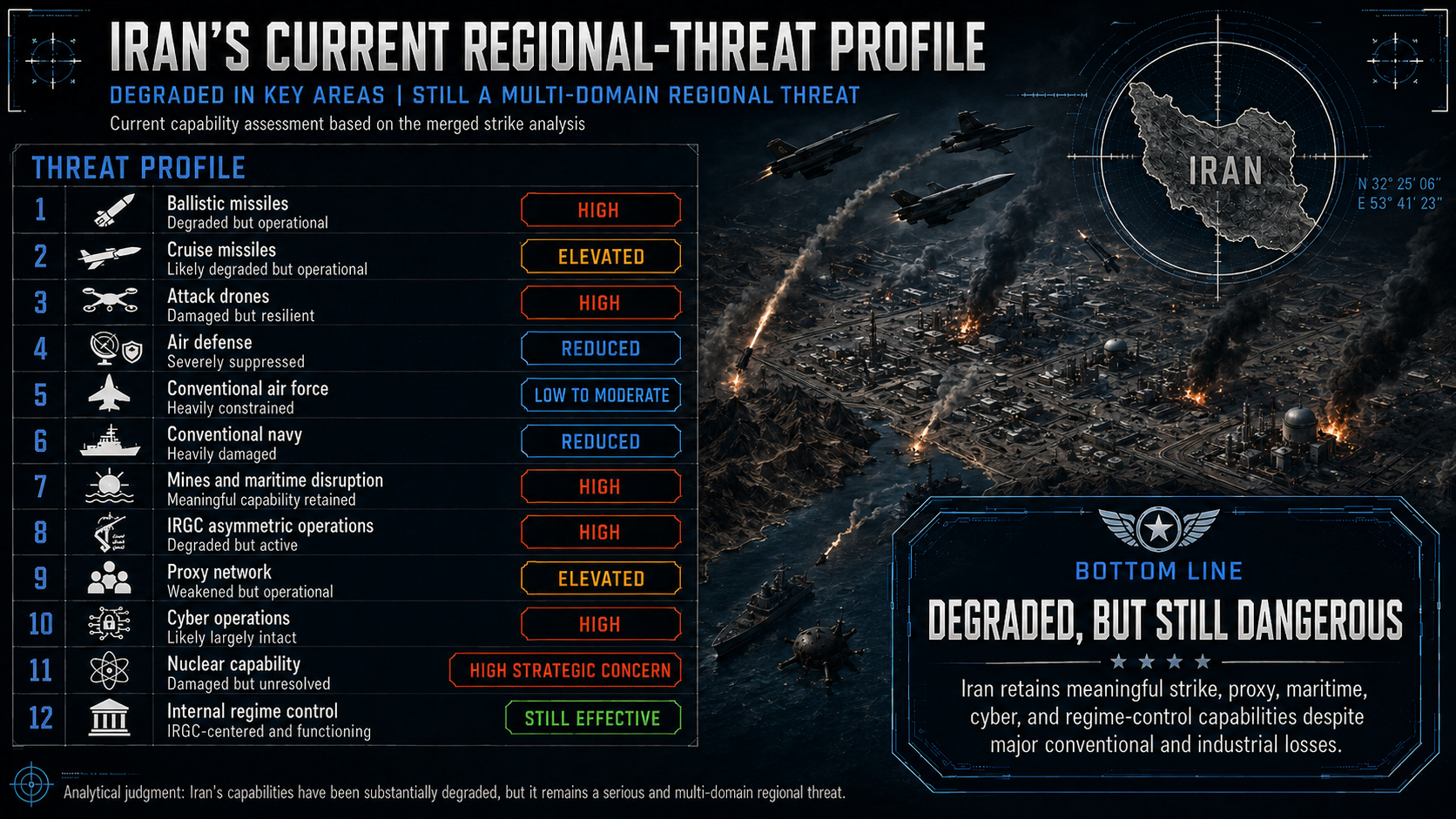
Iran is no longer the same military threat it was before Operation Epic Fury. Its conventional military infrastructure is damaged. Its air defenses are weaker. Its missile-production capacity has been disrupted. Its navy has suffered major losses. Its leadership has experienced severe attrition. Its ability to conduct large, sustained conventional operations has declined.
But weaker does not mean harmless.
Iran remains capable of threatening US military bases, Israel, Saudi Arabia, Qatar, Kuwait, Bahrain, the United Arab Emirates, Iraq, commercial shipping, oil and gas facilities, ports and pipelines, desalination plants, electrical grids, regional aviation, Western interests through cyber operations, and regional governments through proxies and militias.
Iran does not need to defeat the United States conventionally. It needs only to retain enough capability to impose unacceptable economic, military, and political costs through ballistic missiles, cruise missiles, attack drones, naval mines, maritime harassment, cyberattacks, sabotage, proxy attacks, and threats against concentrated Gulf infrastructure.
Current threat profile: Iran remains one of the region's most dangerous actors because it retains multiple ways to escalate without relying on a modern conventional air force or blue-water navy.
Are We Really Close to a Deal?
Close to an interim arrangement. Not a comprehensive settlement.
The United States is involved on the margins and pushing hard for a practical reopening of the Strait of Hormuz, but it is not formally a party to the Iran-Oman track and has drawn clear red lines.
The Official US Position
The Trump administration has staked out a firm public position on the strait itself. Secretary of State Marco Rubio and other senior officials have stated repeatedly that the Strait of Hormuz is an international waterway. No single country, including Iran, gets to control transit, require approvals, or impose tolls and fees on commercial shipping. Rubio has framed the point directly: "International waterways do not belong to any nation state."
President Trump and Treasury Secretary Scott Bessent have publicly said a deal to reopen the strait is close and could be announced imminently. Reporting indicates the White House has been in the loop via Oman and other indirect channels, including through envoy contacts and back-channel messaging.
US officials insist that any temporary arrangement must involve no Iranian permissions for ships and no charges of any kind. CENTCOM continues to describe the southern Omani-side route as free and open.
The administration links progress on Hormuz to broader goals. Restoring a ceasefire. Restarting the June Memorandum of Understanding framework. Eventually returning to nuclear talks. Getting oil and liquefied natural gas flowing again is also a political and economic priority for Washington.
Where Iran Actually Stands
Iran insists the current talks are strictly bilateral with Oman, denies direct US negotiations on the shipping arrangements, and says any real reopening still depends on the United States lifting its naval blockade of Iranian ports and returning to the earlier MOU commitments.
That framing gives Iran three things it wants. Public deniability that it is negotiating directly with Washington. A structural role in setting the routing rules through the bilateral track with Oman. Leverage over any US-facing concession because Tehran can present the arrangement as an Iranian-Omani achievement, not a US-brokered resolution.
The Gap Between Public Position and Emerging Arrangement
There is a gap between the public US red lines and the emerging Iran-Oman understanding. Reporting suggests the temporary routing coordinates mostly through Iranian waters, and Iran would play a larger role over inbound traffic than the "international waterway, no permissions" framing implies. US sources push back against claims that Iran would gain formal control or collect fees. Whether the final text actually respects the no-control and no-fees line, or whether Washington ends up accepting a de facto Iranian role in order to get ships moving, is the live question.
Assessment
A short-term, fee-free, temporary routing deal between Iran and Oman that gets commercial traffic flowing again would be a pragmatic win on the narrow issue of energy security and would lower immediate military tension. That is the most realistic near-term outcome and the one the United States appears willing to facilitate or at least not block.
It would not, however, restore the pre-war status of an open international waterway free of Iranian leverage. Iran would gain formalized influence over the routing, even if temporary, which strengthens its position for the next round of talks. The arrangement is fragile. Any new incident, disagreement over implementation, or failure to lift the US naval blockade could collapse it quickly. It also does not resolve the nuclear file, sanctions, or the deeper security competition.
In short, the United States wants the strait open without handing Iran a lasting veto or revenue stream. It is actively encouraging the Oman channel and signaling readiness to return to the broader MOU framework if the shipping piece moves. Whether the final text delivers that, or whether it is a face-saving compromise that tilts toward Iranian preferences, will become clear if and when the joint Iran-Oman statement is actually released and the United States reacts.
Current diplomacy therefore appears primarily focused on reopening the Strait of Hormuz, establishing safer shipping routes, reducing maritime attacks, ending or modifying restrictions on Iranian ports, restoring a temporary ceasefire, and creating time for additional negotiations.
The parties have not publicly resolved Iran's enriched-uranium stockpile, enrichment limits, IAEA inspection access, ballistic-missile restrictions, long-range missile development, IRGC regional operations, proxy support, sanctions relief, frozen Iranian assets, maritime fees, long-term freedom of navigation, enforcement mechanisms, or consequences for violations.
A real strategic agreement would require a signed and publicly defined text, verified cessation of attacks, sustained reopening of commercial shipping, mine-clearance and maritime-monitoring procedures, an enforceable freedom-of-navigation system, full IAEA access, accounting for enriched uranium, limits on enrichment and rebuilding, restrictions on missile production or deployment, and enforcement provisions for violations.
An interim arrangement could still be valuable. Reopening Hormuz, stopping attacks, stabilizing energy markets, and beginning nuclear negotiations would constitute meaningful progress. It should not be presented as proof that Iran has surrendered or that every US objective has been achieved.
Iran is negotiating after sustaining extraordinary military damage. It retains enough surviving leverage to threaten Gulf infrastructure, influence maritime access, continue missile operations, and demand concessions. That is not unconditional defeat.
The Real Scorecard
What Operation Epic Fury clearly accomplished, and what it did not.
| What Epic Fury Accomplished | What Epic Fury Did Not Accomplish |
|---|---|
| Conducted at least 1,293 confirmed strikes inside Iran | Eliminate Iran's ballistic-missile force |
| Severely damaged Iran's missile and air-defense infrastructure | Eliminate the IRGC |
| Reduced Iran's missile-launch tempo and capacity | Eliminate Iranian maritime coercion |
| Disrupted missile and weapons production | End Iran's ability to threaten Hormuz |
| Suppressed much of Iran's air-defense network | Eliminate proxy activity |
| Functionally constrained Iran's conventional air force | Secure or account for Iran's enriched uranium |
| Inflicted major damage on naval bases, ports, and vessels | Permanently end enrichment capability |
| Damaged IRGC headquarters and security institutions | Create a verified nuclear settlement |
| Killed or displaced senior military commanders | Remove the Iranian regime |
| Damaged power, energy, manufacturing, storage, and transportation infrastructure | Eliminate Iran's regional influence |
| Increased the cost and difficulty of Iranian rearmament | Prevent subsequent missile launches |
| Forced Iran to negotiate under substantial military and economic pressure | Produce a final and enforceable peace agreement |
| Demonstrated overwhelming US and Israeli conventional strike capability |
Final Judgment
Operation Epic Fury was a major military success in terms of target destruction, operational reach, suppression of Iranian conventional defenses, and damage to Iran's military-industrial infrastructure.
The merged OSINT record of 1,293 confirmed strikes reinforces the conclusion that the campaign was considerably broader and more destructive than the initial dataset alone demonstrated.
It was not, however, a complete strategic victory.
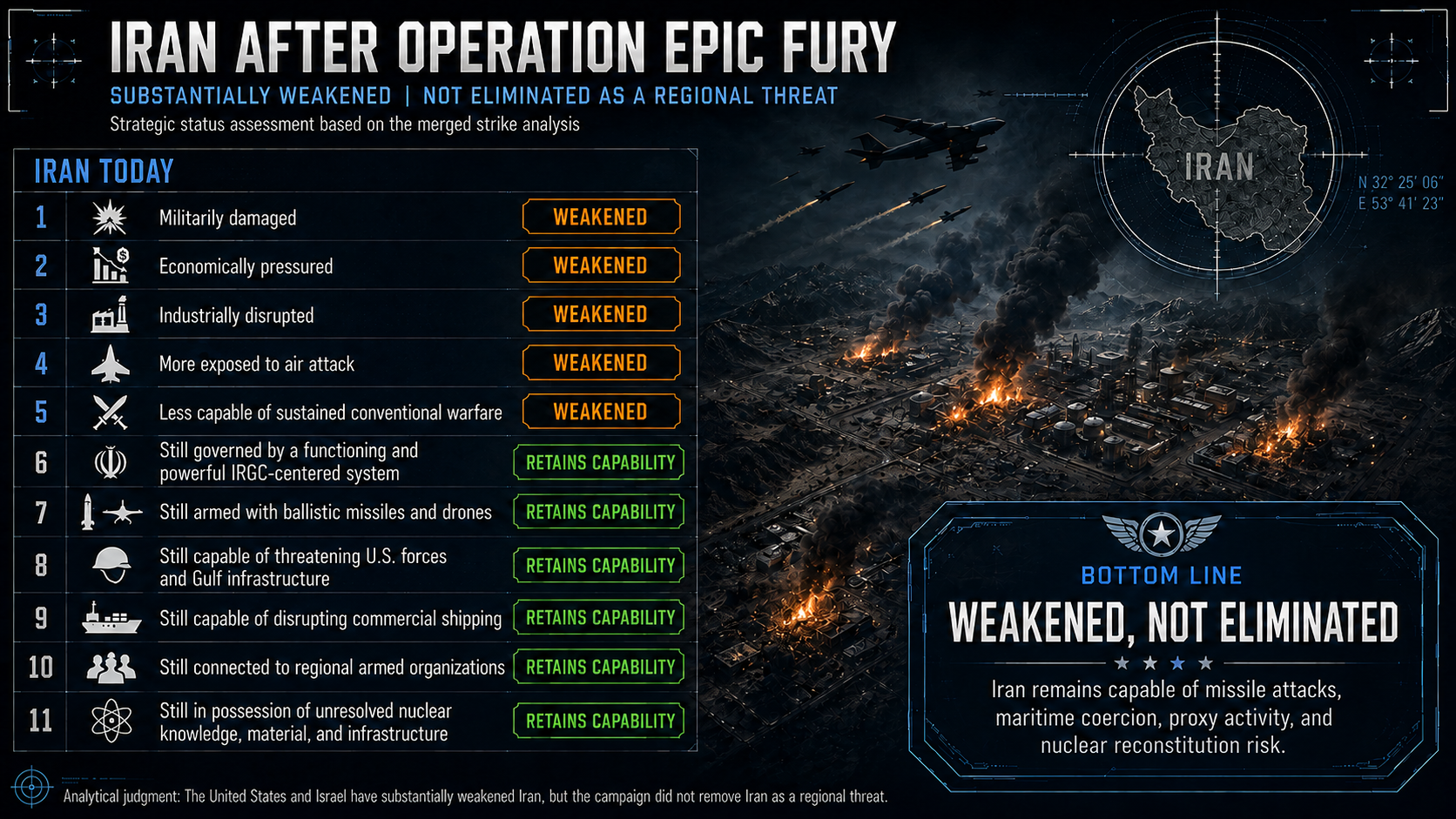
The United States and Israel have substantially weakened Iran. They have not eliminated it as a regional threat.
Iran today is militarily damaged, economically pressured, industrially disrupted, more exposed to air attack, less capable of sustained conventional warfare, still governed by a functioning and powerful IRGC-centered system, still armed with ballistic missiles and drones, still capable of threatening US forces and Gulf infrastructure, still capable of disrupting commercial shipping, still connected to regional armed organizations, and still in possession of unresolved nuclear knowledge, material, and infrastructure.
The fairest conclusion is this. The Trump administration is broadly correct that Operation Epic Fury caused severe and unprecedented damage to Iran's military capabilities. It is overstating the completeness and permanence of that damage. Iran's military power has been degraded, not erased. Its nuclear program has been delayed and obscured, not verifiably eliminated. The IRGC has been disrupted, not dismantled. Iran remains a serious regional threat.
The developing maritime arrangement may represent the beginning of an exit from the war. It does not yet represent a comprehensive Iran agreement.
A real strategic settlement would have to address permanent freedom of navigation, verified mine clearance, ballistic-missile limits, restrictions on missile production, full IAEA access, accounting for enriched uranium, enforceable limits on enrichment, proxy support, IRGC regional operations, sanctions relief tied to verified compliance, and clear penalties for violations.
Until those issues are resolved, the most accurate conclusion is this.
We may be close to a temporary ceasefire and shipping agreement. We are not yet close to resolving the Iranian nuclear, missile, IRGC, proxy, and regional-security threats.
This brief draws on the MERIDIAN Operation Epic Fury OSINT dataset, containing 4,938 sourced records and 4,303 dated event pins consolidated into approximately 1,968 unique dated events. The 1,293 confirmed strikes cited in this analysis are those meeting MERIDIAN's classification threshold for confirmed status. Additional strikes classified as probable are excluded from headline counts. Target-category assignments are best-effort based on open source information; some strikes could plausibly fit multiple categories and totals should be read as approximate. Administration claims and CENTCOM percentages cited in this brief are attributed to their sources and not independently verified. Confidence is highest on strike counts by category and lowest on percentage claims about total Iranian capability destroyed.
- MERIDIAN SPECTRE Operation Epic Fury OSINT dataset. 4,938 sourced records, 4,303 dated event pins, 1,293 confirmed strikes as of August 2, 2026.
- US Central Command (CENTCOM) public statements on Operation Epic Fury outcomes and the Omani-side Hormuz route, June to August 2026.
- Secretary of State Marco Rubio public statements on the Strait of Hormuz as an international waterway, July to August 2026.
- Treasury Secretary Scott Bessent public statements on the Hormuz reopening timeline, August 2026.
- White House statements and Trump administration public remarks on Iran deal negotiations, July to August 2026.
- Reporting on the Iran-Oman bilateral track for Hormuz routing arrangements, July to August 2026.
- Israeli Defense Forces (IDF) operational communications and strike reports, February to August 2026.
- UK Maritime Trade Operations (UKMTO) and industry maritime advisories on Strait of Hormuz activity.
- International Atomic Energy Agency (IAEA) public statements and reports on Iranian nuclear facility status.
- Wire service reporting from Associated Press, Reuters, and Agence France-Presse on Iran war developments.
- Sentinel-2 and commercial satellite imagery analysis published by open source analysts.
- Prior MERIDIAN briefs on the Iran war and Strait of Hormuz dynamics.