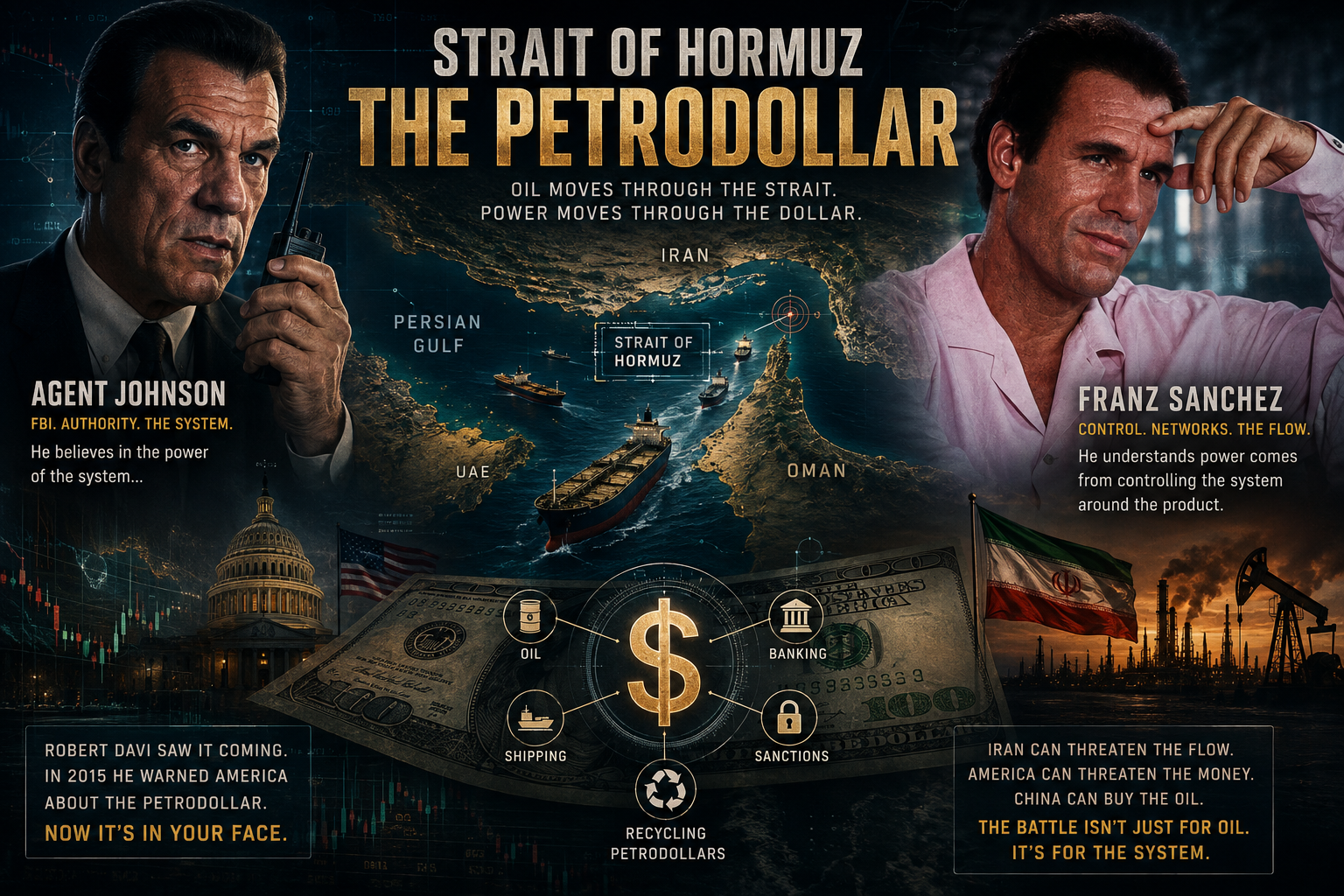
Robert Davi played an FBI agent trying to stop terrorists and a Bond villain commanding a narcotics empire. In 2015, he identified a different kind of power struggle. One involving oil, currency, and the financial architecture beneath American global influence. More than a decade later, the Strait of Hormuz has placed that warning directly in front of us.
Before Robert Davi wrote about the petrodollar, most Americans knew him from two unforgettable roles.
In Die Hard, he played FBI Special Agent "Big" Johnson, the aggressive federal agent who arrived at Nakatomi Plaza convinced that Washington knew how to take control.
One year later, in the James Bond film Licence to Kill, Davi became Franz Sanchez, the calculating narcotics lord whose empire was built not merely on violence but on logistics, loyalty, political influence, banking relationships, and control over the movement of a valuable commodity.
That combination now feels strangely appropriate.
The FBI agent and the narcotics kingpin both understood, at least fictionally, that real power does not come from possessing the product alone. It comes from controlling the system surrounding it. The transportation, financing, enforcement, relationships, and rules.
Then, in October 2015, Davi stepped outside Hollywood and wrote about the system surrounding the world's most strategically important commodity.
His Breitbart article was titled: "Putin and the Petrodollar, What You Didn't Hear at the Democratic Debate." It was published October 16, 2015.
Davi argued that while American politicians debated personalities and domestic talking points, Russia, China, and Iran were positioning themselves against one of the foundations of American power: the dollar-centered global energy system.
More than a decade later, Iran is using the Strait of Hormuz to demonstrate where physical control over energy meets financial control over the marketplace.
The actor who played an FBI agent and one of James Bond's most formidable villains saw the strategic picture before much of Washington appeared willing to discuss it.
Good job, Agent Johnson.
What Davi Saw in 2015
Davi's central warning was that America's global position depended on more than military strength.
It also depended on the world's willingness, and practical need, to use the dollar.
After the United States ended the dollar's direct convertibility into gold in 1971, Washington deepened its economic and security relationship with Saudi Arabia. Saudi oil continued to be sold primarily in dollars, Saudi oil revenues flowed into American securities and financial institutions, and the United States reinforced its security commitments in the Persian Gulf.
Over time, oil producers, traders, banks, insurers, and governments built an enormous marketplace around dollar-denominated energy.
Countries that needed oil needed access to dollars. Countries that accumulated oil revenue frequently invested those dollars in U.S. Treasury securities, banks, property, weapons, and other American assets.
This process became known as petrodollar recycling.
Davi's 2015 article warned that the structure was becoming vulnerable. China was becoming the central customer for many energy producers. Russia wanted to weaken American financial dominance. Iran had powerful reasons to escape dollar-based sanctions. Saudi Arabia was questioning the reliability of American security commitments.
The article was politically provocative and occasionally overstated the simplicity of the petrodollar arrangement. There is no universal contract requiring every barrel of oil to be sold exclusively in dollars.
But Davi correctly identified the larger strategic issue.
The currency and financial system through which energy is sold can be as important as the energy itself.
His warning was not merely that another currency might appear on an invoice. It was that a rival system could gradually develop around the oil market. A system of alternative currencies, bilateral agreements, barter, non-Western banks, and payment channels designed to reduce the power of Washington.
That process is now visible.
The Villain Who Understood the Supply Chain
There is an almost uncomfortable symbolism in Davi's best-known roles.
Franz Sanchez was not dangerous simply because he possessed narcotics. He controlled a network. He had production, transportation, political protection, financial connections, loyal operators, and access to markets. Bond did not defeat Sanchez merely by destroying his product. He destabilized the relationships and trust holding the organization together.
The international oil system operates on a vastly different moral and economic plane, but the strategic principle is recognizable.
Oil must be extracted, shipped, insured, financed, priced, cleared, and delivered.
The country that influences each of those steps possesses far more power than a country that merely owns petroleum reserves.
The United States does not control all the world's oil. It does, however, sit near the center of the banking, financial, sanctions, insurance, and security networks surrounding a large portion of international commerce.
Iran's challenge is therefore not simply to sell oil. It is to sell oil while evading a system designed to monitor, restrict, and punish the transaction.
In that sense, Davi's argument was never just about barrels. It was about the architecture around the barrels.
Shawn Ryan Brings the Question Back
The petrodollar has also appeared repeatedly in discussions connected to The Shawn Ryan Show.
Ryan, a former Navy SEAL and CIA contractor, has created a platform where veterans, intelligence professionals, political figures, and independent commentators frequently challenge the official explanations surrounding American foreign policy.
In an August 2023 interview with former special-operations soldier Tony Cowden, the discussion connected American military intervention, oil-producing governments, and attempts to move energy trade away from the dollar.
The discussion did not prove that the Iraq War or every American military action was fought to protect the petrodollar. But it reflected a growing suspicion among veterans and former national-security personnel that the financial interests beneath foreign policy are often underexplained to the public.
In a May 2026 conversation with Cenk Uygur, Ryan again raised the petrodollar. The discussion explained that international demand for dollar-priced energy helped create demand for dollars and U.S. Treasury securities, thereby supporting lower American borrowing costs and wider U.S. financial influence.
That is an important distinction.
The serious argument is not: every war is secretly and exclusively about the petrodollar.
The serious argument is: currency dominance, energy security, and military power reinforce one another, and governments consider all three when making strategic decisions.
That proposition is neither fringe nor conspiratorial. The current administration states openly that the dollar's reserve-currency position is a national asset.
Does the Trump Administration Understand the Dollar Issue?
The answer is yes. But its approach is broader than the traditional petrodollar.
Treasury Secretary Scott Bessent has explicitly described reserve-currency status as a source of American economic and national power. In February 2026, he said that reserve status supports lower borrowing costs, deeper capital markets, stronger sanctions, and American leadership in global finance.
Bessent has also said that the administration maintains a long-term strong-dollar policy, even while acknowledging that exchange rates can fluctuate and that the dollar may move differently against individual currencies in the short term.
The administration has promoted dollar-backed stablecoins as another mechanism for extending American currency dominance into digital finance. When President Trump signed the GENIUS Act in July 2025, Bessent said dollar-backed stablecoins could increase worldwide access to the dollar and create additional demand for Treasury securities.
The administration's 2025 National Security Strategy is even more direct. It identifies the dollar's reserve-currency status as one of America's principal strategic advantages and calls for policies that bind developing financial markets more closely to the dollar. The same strategy identifies an open Strait of Hormuz and preventing hostile control over Gulf energy as continuing American interests.
Therefore, it would be inaccurate to say the administration does not understand the strategic value of the dollar. It clearly does.
The more useful criticism is that the administration does not publicly connect its dollar policy, Iran strategy, sanctions, energy policy, and Hormuz operations into one coherent explanation for the American people.
The components exist:
- Preserve dollar reserve status.
- Expand dollar-backed digital payments.
- Maintain the strength of the Treasury market.
- Use financial sanctions against Iran.
- Stop Iranian oil and banking networks.
- Keep Hormuz open.
- Prevent Iran from charging or controlling passage.
- Increase American oil and gas production.
- Reduce strategic dependence on hostile energy chokepoints.
That is not an absence of strategy. It may be an absence of public articulation.
Hormuz. The Physical Choke Point.
The Strait of Hormuz is the world's most important oil chokepoint.
Historically, approximately 20 million barrels of oil and petroleum products have passed through the strait each day. That represents roughly one-fifth of global petroleum consumption and more than one-quarter of seaborne oil trade.
Large volumes of liquefied natural gas, particularly exports from Qatar, also move through Hormuz.
The route matters even though most of its energy is destined for Asia rather than the United States.
A closure or sustained disruption immediately affects global prices. American motorists, farmers, manufacturers, and consumers feel the effects regardless of whether a particular tanker was headed to China, India, Japan, or South Korea.
But the strategic importance goes beyond price.
Hormuz is where physical energy flows meet the dollar-centered financial system.
Iran possesses geography, missiles, mines, drones, and coastal forces.
The United States possesses naval power, dollar clearing, sanctions authorities, capital markets, and influence over the banks, insurers, and commercial institutions surrounding maritime trade.
The current struggle is therefore a confrontation between two different chokepoints.
Iran can threaten the physical passage of oil. The United States can threaten access to the financial system needed to sell it.
Iran Does Not Need to Close Hormuz Completely
A permanent closure would cause enormous damage to Iran itself.
Iran needs oil revenue. It needs trade with China and other Asian customers. It cannot indefinitely prevent every commercial vessel from transiting without turning crucial partners against it.
A more effective strategy would be selective control.
Iran could attempt to determine which vessels pass, which companies register with Iranian authorities, which countries receive preferential treatment, and whether fees or other concessions are required.
It could favor countries that purchase Iranian oil, resist American sanctions, or accept non-dollar settlement arrangements.
It could allow limited traffic while preserving enough risk to increase insurance costs and force shipping companies and governments to deal directly with Tehran.
This would transform Hormuz from a shared international waterway into a source of Iranian political and economic leverage.
The dispute would then become larger than freedom of navigation.
It would become a fight over who writes the commercial rules of the strait.
The Administration May Be Defending More Than Shipping
The Trump administration publicly describes its immediate objectives in terms of security and nuclear policy:
- Reopen the Strait of Hormuz.
- Prevent Iran from obtaining a nuclear weapon.
- Protect American forces and allies.
- Restore predictable commercial shipping.
- Stop Iran from imposing unauthorized charges or passage requirements.
- Reduce the revenue supporting the Iranian government and Islamic Revolutionary Guard Corps.
Those are legitimate and publicly stated goals.
There is no publicly available evidence establishing that the present conflict was initiated principally to protect the petrodollar.
But those objectives also preserve the dollar-centered energy order.
Reopening Hormuz restores predictable oil flows.
Preventing Iranian tolls denies Tehran the ability to impose a new financial layer over Gulf energy.
Sanctioning Iranian banks and shadow financial networks preserves the reach of American economic power.
Targeting Iran's shadow fleet protects the integrity of Western shipping and insurance restrictions.
Preventing Iran from building preferential arrangements with China protects American influence over the region's commercial system.
The administration may not call this a petrodollar operation. Its actions nevertheless affect the same architecture.
A New Energy-Dollar Strategy
The administration's strategy may also be evolving beyond the old model.
The traditional petrodollar system depended heavily on protecting Persian Gulf oil and ensuring that producers recycled dollar revenues into American assets.
The emerging model may place greater emphasis on the United States as both the financial center and the energy supplier.
America is now a major producer and exporter of oil and natural gas. A prolonged Hormuz crisis makes American energy more valuable because it does not have to pass through the Iranian-controlled chokepoint.
That creates a potential new structure:
- American energy production.
- American export infrastructure.
- Dollar-denominated contracts.
- U.S.-linked financing and insurance.
- Dollar-backed digital settlement.
- Treasury securities supporting global dollar liquidity.
Under this model, the United States would not merely defend the currency used to purchase Middle Eastern oil. It would increasingly supply the energy, finance the transaction, and control the payment system.
The administration's policies on domestic production, LNG exports, stablecoins, sanctions, and dollar reserve status make more sense when viewed together.
The question is whether this is a fully coordinated strategic doctrine or a collection of policies whose combined significance has not yet been publicly explained.
The Qaddafi Question
Any serious discussion of the petrodollar eventually reaches Libya and Muammar Qaddafi.
Qaddafi spent years advocating greater African political and economic unity. His ambitions included stronger continental institutions, shared defense arrangements, and proposals for an African currency less dependent on Western monetary systems.
He also discussed a gold-backed African dinar that could potentially be used in trade, including transactions involving oil and other natural resources.
The theory that followed is now familiar. Qaddafi intended to unite African governments behind a gold-based currency, require gold or the new currency for Libyan and African oil, weaken the dollar and euro, and challenge Western financial influence over Africa.
According to this theory, France, the United States, and NATO viewed that plan as a strategic threat, contributing to the decision to intervene in Libya in 2011.
There is some evidence that makes the question legitimate.
An April 2011 intelligence memo sent by Sidney Blumenthal to Secretary of State Hillary Clinton alleged that Qaddafi's government held substantial quantities of gold and silver intended, in part, to support a pan-African currency. The memo claimed that French President Nicolas Sarkozy was concerned about the plan's potential to challenge the French franc-linked monetary system in Africa.
The existence of the memo is real. Its allegations, however, came from unnamed sources and were not an official intelligence-community judgment. Contemporary reporting described the information as unverified and speculative.
Officially, the United States and NATO justified military action under United Nations Security Council Resolution 1973, which authorized measures to protect civilians during Qaddafi's violent response to the Libyan uprising. U.S. officials repeatedly cited civilian protection and enforcement of the resolution as the legal and policy basis for intervention.
Those official explanations do not prove that no economic motivations existed.
Governments can have multiple motivations simultaneously. Humanitarian concern. Alliance pressure. Regional stability. Oil supply. European security. Domestic politics. Regime change. Monetary and financial interests.
But the available public evidence does not permit an honest writer to state as fact that Qaddafi was removed because he threatened the petrodollar.
We can ask the question. We can analyze the incentives. We can point to the Blumenthal memo. We can observe that a successful gold-backed African oil currency would have challenged both dollar and euro influence. But we must distinguish reasonable speculation from proven causation.
Could Qaddafi's Currency Plan Have Worried Washington?
Absolutely.
Had Qaddafi successfully persuaded major African or Middle Eastern oil producers to settle energy sales in a gold-linked currency, it could have produced several strategic consequences:
- It could have reduced demand for dollars in participating transactions.
- It could have weakened French monetary influence in former colonies using the CFA franc.
- It could have increased Libya's political leadership in Africa.
- It could have provided sanctioned or anti-Western governments with an alternative financial channel.
- It could have transformed Libya's gold reserves into geopolitical leverage.
It also could have failed.
African governments had different economic interests, monetary systems, and political loyalties. A gold-backed common currency would have required institutional trust, fiscal coordination, credible reserves, convertibility, and agreement among governments that frequently disagreed.
Qaddafi was skilled at announcing grand continental projects that did not always become functioning institutions.
Therefore, the gold dinar was potentially threatening as an idea, but far from guaranteed as a practical system.
The responsible conclusion is: Qaddafi's monetary project was real enough to concern Western policymakers, especially France, but the assertion that it caused the U.S.-NATO intervention remains unproven.
That uncertainty does not make the question illegitimate. It makes careful wording essential.
The Pattern That Deserves Examination
Qaddafi was not the only leader to consider moving energy transactions away from the dollar.
Saddam Hussein and the Iraqi Euro Shift
In October 2000, Iraq switched its United Nations Oil-for-Food Programme sales from dollars to euros. Saddam Hussein publicly framed the move as a rejection of the dollar as "the currency of the enemy." Iraqi oil continued to flow, but revenues were denominated in euros for roughly two and a half years.
In March 2003, the United States and its coalition partners invaded Iraq. Within weeks of the invasion, Iraqi oil sales returned to dollar denomination. The Coalition Provisional Authority also restored dollar-based settlement across Iraqi state accounts.
The official justification for the war was weapons of mass destruction and regional security. Those explanations were separate from currency policy. The available evidence does not permit an honest writer to state as fact that Iraq was invaded because of its euro switch. But the sequence is real. Iraq moved away from the dollar. Iraq was invaded. Iraqi oil sales returned to dollars. Those three facts, in that order, deserve to be part of any serious discussion of what currency-related decisions actually cost.
Nicolas Maduro and the Venezuelan Alternative
Venezuela provides the counterexample that strengthens the pattern rather than weakening it.
After the United States imposed comprehensive sanctions on Venezuelan oil in 2019, the Maduro government moved aggressively to sell oil in currencies other than the dollar. Transactions were denominated in yuan, euros, rubles, and sometimes barter arrangements involving refined-product swaps. Venezuela used sanctions-evading shipping networks, disabled AIS transponders, and layered corporate intermediaries to sell to Chinese, Russian, Cuban, and Iranian customers.
The United States did not respond with military invasion. It responded with more sanctions, asset freezes across the global banking system, the seizure of Citgo assets in US territory, secondary sanctions against Chinese refineries handling Venezuelan crude, and selective licenses to companies like Chevron that gave Washington leverage over Venezuelan oil production without regime change.
Maduro is still in power. Venezuelan oil is still sold outside the dollar system where possible. But the Venezuelan economy has been severely damaged. The country produces roughly a fifth of the oil it produced in the late 1990s. Millions of Venezuelans have fled. The financial pressure has been closer to strategic strangulation than to regime change through force.
That is the important observation. When the United States could not or would not use military force, it used the dollar itself as the weapon. The response was different. The strategic concern about currency independence was not.
The Pattern in One View
Three governments moved away from the dollar. The US response varied. The strategic anxiety in Washington did not.
| Country / Leader | Move Away From Dollar | US Response | Outcome |
|---|---|---|---|
| Iraq / Saddam Hussein | Oct 2000. Oil-for-Food sales switched from dollars to euros. | March 2003 invasion. Official justification was WMD and regional security. | Regime removed. Saddam executed 2006. Oil sales returned to dollars within weeks of the invasion. |
| Libya / Muammar Qaddafi | Advocated for gold-backed pan-African dinar. Discussed pricing Libyan and African oil in gold or the new currency. | 2011 NATO intervention under UN Security Council Resolution 1973. Official justification was civilian protection. | Regime removed. Qaddafi killed. Libyan gold reserves partly seized during the transition. Currency project abandoned. |
| Venezuela / Nicolas Maduro | Post-2019 sanctions. Oil sold in yuan, euros, rubles, and barter. Sanctions-evading shipping networks used to reach Chinese and other buyers. | Financial pressure rather than military force. Comprehensive sanctions, Citgo asset seizure, secondary sanctions on foreign refiners, selective licenses to US oil majors. | Maduro remains in power. Venezuelan oil sector operates at roughly a fifth of late-1990s output. Millions of Venezuelans have emigrated. Financial strangulation without regime change. |
| Iran / Islamic Republic | Decades of non-dollar oil sales through barter, intermediaries, and informal networks. Sales to China in yuan. Sanctions-evading shadow fleet. | Sustained sanctions across multiple administrations. Coordinated military action in 2026 tied to nuclear program and Hormuz shipping. | Ongoing. As of August 2026, Iran retains its government, damaged nuclear program, and residual leverage over Hormuz. See MERIDIAN daily SITREPs for current developments. |
The comparison does not prove causation. It shows correlation strong enough to justify serious analysis.
Iraq made the move. Iraq was invaded.
Libya made the move. Libya was intervened against.
Venezuela made the move. Venezuela was strangled financially.
Iran is making the move. Iran is at war.
That is not a claim that each war was fought exclusively over currency. It is a claim that governments in Washington have consistently treated currency independence as a strategic problem, and that the tools chosen to respond have varied with the political and military circumstances of each case.
Other leaders considered similar moves. Russia expanded local-currency and yuan-based energy trading after Western sanctions. China has promoted yuan-denominated oil contracts and bilateral settlement arrangements. Neither of those developments, individually, ended dollar dominance.
But together they demonstrate a consistent strategic objective among governments seeking to reduce American influence.
Escape the system Washington can control.
That does not prove that the United States attacks every government that challenges the dollar. Venezuela is the direct counterexample. It does show why American officials would treat large-scale movement away from the dollar as a national-security concern, and why the response tools have expanded to include financial as well as military options.
The Dollar Is More Than the Petrodollar
It is also important not to exaggerate the role of oil.
The dollar would remain globally important even if more oil were sold in other currencies.
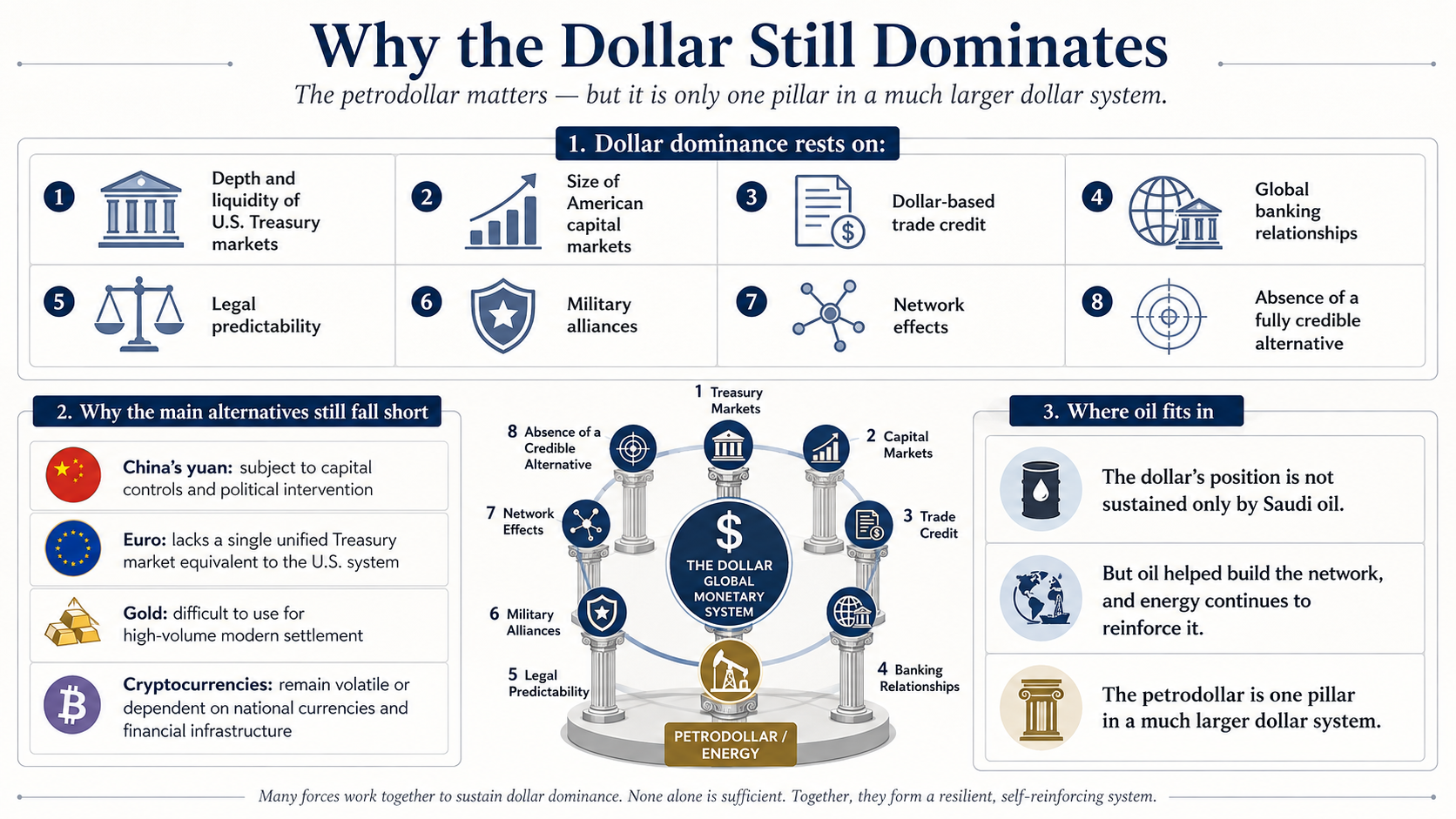
Dollar dominance rests on:
- The depth and liquidity of U.S. Treasury markets.
- The size of American capital markets.
- Dollar-based trade credit.
- Global banking relationships.
- Legal predictability.
- Military alliances.
- Network effects.
- The absence of a fully credible alternative.
China's yuan remains subject to capital controls and political intervention.
The euro lacks a single unified Treasury market equivalent to the American system.
Gold is difficult to use for high-volume modern settlement.
Cryptocurrencies remain volatile or dependent on national currencies and financial infrastructure.
The dollar's position is therefore not sustained only by Saudi oil.
But oil helped build the network, and energy continues to reinforce it.
The petrodollar is one pillar in a much larger dollar system.
America's Dangerous Contradiction
The United States uses the dollar as a weapon because the weapon works.
Sanctions can freeze assets, isolate banks, block transactions, and make it extraordinarily difficult for adversaries to move money internationally.
But every use of that weapon encourages the target to develop an alternative.
Iran has spent years building shadow banking channels, front companies, opaque shipping structures, and non-dollar transactions.
Russia developed new settlement mechanisms after sanctions.
China has created cross-border payment infrastructure and currency-swap relationships.
These systems remain smaller, less efficient, and less trusted than the dollar network. But they are growing because governments now understand that access to the dollar can be withdrawn.
The contradiction is straightforward.
American financial power is strongest when everyone uses the dollar. The aggressive use of that power gives other countries a reason to stop using it.
Washington must therefore balance enforcement with stewardship. A reserve currency cannot survive on coercion alone. It survives because participants believe the system is stable, liquid, predictable, and more beneficial than the alternatives.
The Architecture Now Being Tested in Real Time
Since the current Iran war began, financial analysts and international press have documented a pattern that Davi did not describe in 2015 but that fits the same architecture. Unusually large positions have appeared in oil futures, energy stocks, and prediction markets around Trump's public statements on Iran, including announcements made just before the Monday openings of US trading. The Guardian, Le Monde, and other outlets have covered the pattern. No specific individual has been legally implicated, and formal investigations are limited by the difficulty of tracing trades in fragmented markets.
But the pattern itself is instructive. When war news, currency effects, and financial markets are as tightly linked as they are now, advance knowledge of any single decision can become a source of private profit. That is what Davi meant when he warned that the architecture around the barrels matters as much as the barrels themselves. The system he described is now being tested in real time by individuals who may or may not be identifiable, in ways that markets are only beginning to price.
A related and more sensitive dynamic has begun to appear in the negotiations themselves. Public reporting suggests that Iran has begun distinguishing between specific US officials in its diplomatic posture. Mediators have reportedly been told that Iran views different Americans as more or less reliable partners. US officials, including Vice President JD Vance, have publicly denied the specific allegations that have appeared in some accounts.
But even setting the specific claims aside, the fact that Iran is now negotiating against the American team by individual name is itself a strategic development. It means the negotiation is no longer solely a state-to-state conversation. It is also a series of parallel personal conversations that Iran is attempting to influence separately. That fragmentation is itself a threat to the coherence of the position Davi assumed was one integrated American system.
Was Robert Davi Right?
Not completely.
The petrodollar did not collapse after his 2015 article. Saudi Arabia did not suddenly abandon the dollar. Russia and China did not immediately replace the Western financial system.
But Davi saw the direction of travel.
He understood that China's rise as an energy customer mattered. He understood that Russia viewed the dollar as an instrument of American power. He understood that Iran's confrontation with Washington was financial as well as military. He understood that Saudi confidence in American protection could affect more than foreign policy.
Most importantly, he understood that the American public was rarely told how currency power, oil, and military strategy fit together.
That omission continues today.
The administration discusses Iran's nuclear program. It discusses shipping. It discusses sanctions. It discusses American energy dominance. It discusses stablecoins and the dollar's reserve status. It discusses Treasury-market strength.
But it seldom presents these policies as parts of the same strategic system.
Robert Davi did.
Agent Johnson, Franz Sanchez, and the Real Nature of Power
In Die Hard, Special Agent Johnson believed federal authority could overwhelm the crisis at Nakatomi Plaza.
In Licence to Kill, Franz Sanchez understood that control depended on a network of loyalty, finance, transport, and fear.
Robert Davi's petrodollar article combined elements of both perspectives.
He recognized the formal power of the United States. He also recognized that power depends upon a network that adversaries can undermine.
The dollar is powerful because countries use it. Treasuries are powerful because governments and investors trust them. Sanctions are powerful because access to American markets matters. The U.S. Navy is powerful because it protects a commercial system that governments and businesses need.
If enough countries build functional alternatives, each of those advantages becomes slightly less absolute.
No single oil sale in yuan will end the dollar. No gold transaction will overturn the global system. No bilateral agreement will eliminate the Treasury market.
But systems rarely collapse in one dramatic moment.
They erode through thousands of decisions made by governments, companies, and banks seeking another option.
Now It Is in Our Face
In recent days the United States has launched fresh strikes on Iran, then paused attacks, then intercepted an Iranian missile attack in progress. Each of those events has been treated by American media as a discrete Iran war news story. Together they form the operational surface of a much larger contest.
The war over Hormuz is not exclusively a war over the petrodollar.
It is a conflict involving nuclear weapons, regional control, military deterrence, sanctions, shipping, regime survival, energy prices, and the balance of power between the United States, Iran, and China.
But the monetary dimension is real.
Iran controls geography. America controls much of the financial architecture. China controls enormous purchasing demand. The Gulf states control critical production capacity.
The struggle is over how those forms of power fit together.
- Who controls the oil?
- Who controls the route?
- Who controls the transaction?
- Who controls the currency?
- Who can punish a bank for processing the payment?
- Who can insure the ship?
- Who can deny entry to the market?
- Who writes the rules?
Robert Davi raised those questions in 2015.
Shawn Ryan and his guests later brought them before an audience increasingly suspicious of foreign-policy explanations that stop at the water's edge.
Qaddafi's gold-dinar ambitions remind us that other leaders also recognized the strategic relationship between natural resources and monetary sovereignty. Even though the claim that his currency proposal caused NATO's intervention remains unproven.
The Trump administration clearly understands the importance of dollar dominance. Its own strategy documents, Treasury policies, stablecoin initiatives, and financial sanctions demonstrate that.
What remains unclear is whether the administration has fully integrated that understanding into its public explanation of the Iran conflict. Or whether the American people are once again being given separate pieces of a picture no one in Washington wants to assemble out loud.
The actor saw the plot developing. The Bond villain understood the network. The FBI agent understood the power of the system.
And now the Strait of Hormuz has brought all three lessons together.
Good job, Agent Johnson.
This piece is an analytical essay, not a spot report. It draws on Robert Davi's October 2015 Breitbart article, publicly released statements by Treasury Secretary Scott Bessent, the July 2025 GENIUS Act signing, the 2025 National Security Strategy, discussions on The Shawn Ryan Show with Tony Cowden (August 2023) and Cenk Uygur (May 2026), and the April 2011 Blumenthal memo to Secretary Clinton on Libya. Speculative claims about Qaddafi and the petrodollar are labeled as speculative throughout. This piece does not assert unproven causation. It examines the strategic architecture connecting energy, currency, and military policy.
- Robert Davi. "Putin and the Petrodollar, What You Didn't Hear at the Democratic Debate." Breitbart, October 16, 2015.
- Treasury Secretary Scott Bessent, public statements on reserve-currency status and strong-dollar policy, February 2026.
- GENIUS Act stablecoin legislation. Signed by President Trump, July 2025. Bessent commentary on dollar-backed stablecoins and Treasury security demand.
- National Security Strategy of the United States, 2025 edition. Discussion of dollar reserve-currency status and Strait of Hormuz as continuing American interests.
- The Shawn Ryan Show. Interview with Tony Cowden, August 2023. Interview with Cenk Uygur, May 2026.
- Sidney Blumenthal memo to Secretary of State Hillary Clinton, April 2011. Regarding Libyan gold reserves and pan-African currency ambitions. Unverified sourcing acknowledged.
- United Nations Security Council Resolution 1973 (2011). Legal basis for NATO intervention in Libya.
- US Treasury Office of Foreign Assets Control (OFAC) sanctions regimes against Iran, Venezuela, and other targeted governments.
- The Guardian. Reporting on unusual speculative bets and market positioning around Iran war announcements. April 18, 2026.
- Le Monde. Opinion coverage of suspicious transactions in oil markets during the Iran war. May 12, 2026.
- Drop Site News. Reporting on Iran-US negotiation dynamics and allegations regarding individual US officials. July 15, 2026. Referenced only for the structural point that Iran has begun distinguishing between specific US officials in its diplomatic posture. Specific allegations regarding named US officials are contested and denied by the US government and by the officials named.
- MERIDIAN SPECTRE facility tracking dataset for Iran, IRGC, and Gulf naval assets.